 Art and Photo Presentations from All-Creatures.org
Art by Barry Kent MacKay
In this section are copies of original works of art. All of them are dedicated to helping us live according to unconditional love and compassion, which is the foundation of our peaceful means of bringing true and lasting peace to all of God's creatures, whether they are human beings or other animals.
Loggerhead Shrike (Lanius ludovicianus migrans)

(Artwork - 256)
Loggerhead Shrike (Lanius ludovicianus migrans)
When I was a kid, a rather long time ago, my parents would drive me around the rural belt that then surrounded Toronto, looking for birds, and one we saw with reasonable frequency was the beautiful Loggerhead Shrike, so distinctive in the soft gray, black, and white patterning. I remember seeing families that were not unlike what I have shown in my oil painting. Now, in all of Canada, they are formerly listed as Critically Endangered. Overall, the International Union for Conservation of Nature lists this species, found only in North America (including a bit of Mexico) as Near Threatened, I think the situation is more dire. There are only about three dozen breeding pairs in Canada and that is thanks to spectacular effort by the Toronto Zoo, McGill University and Wildlife Management Canada to breed and release birds into protected (but potentially vulnerable) habitat, that I have often visited. The species has seven distinct subspecies, geographic variations, and the subspecies found only on San Clemente Island (L. l. mearnsi) is listed as Critically Imperiled. It, too, has benefitted from a breeding and release program. I have shown the subspecies found (or in many areas formerly found) in much of eastern North America (L. l. migrans).
Shrikes are predatory, even though the Loggerhead is a songbird and weighs around 50 grams (just over an ounce – a house sparrow tops the scales at about 40 grams, and yet may form the prey for the shrike -- although shrikes are eclectic in their dietary choices, which include small herptiles, small mammals and birds, and large arthropods.) Their feet are weak, so they kill prey with a beak that has a sharp hook near the tip and another just past the tip, combined with a quick twisting motion to damage or destroy nervous systems. They have strong neck musculature to facilitate quick dispatching of small vertebrates. They have earned the nickname “butcherbird” because they often hang their prey impaled on a sharp thorn, or perhaps a barb wire fence, at times storing it for future consumption.
What continually mystifies me is why their numbers have plummeted, given that their favored habitat (which varies geographically) seems widespread. It seems to be loss of some prey (such as large insects) perhaps combined with extra sensitivity to pollutants, such as pesticides. But then they are “field birds” in a sense (although they need hedgerows or woodland edges and lookout posts) and that group of birds has suffered greatly from urbanization, roadkills, early harvests, and other anthropogenic factors.
I’ve shown one adult and three young approximately life size on the original oil painting.
 Previous
Return to Art by Barry Kent MacKay - Page 5
Copyright © Barry Kent MacKay
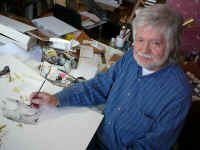
Barry describes himself as a Canadian artist/writer/naturalist.
See his website: www.barrykentmackay.com
For purchasing of original art, prints and other products GO HERE.
Return to Art by Barry Kent MacKay
Return to Art By Various Artists
Return to Art and Photo Journals and Galleries
Posted on All-Creatures: October 6, 2025
Follow us on:


- Home Page
- What's New
- Contact Us
- Action Alerts
- Animal Exploitation
- Animal Issues
- Animal Rights Activism
- Archives
- Art & Photography
- Articles Directory
- Bible
- Bible Commentary Blog
- Books
- Campaigns
- Church & Religion
- Discussions
- Events / Podcasts / Media
- Health
- Hosted Web Sites
- Humor
- Kids' Korner
- Letters
- Links
- Nature Studies
- Newsletter
- Poetry & Stories
- Prayers
- Quotations
- Recipes with Photos
- Recipes Without Photos
- Sermons
- Stop Cruelty in Churches
- Video Library
- The Mary T. and Frank L. Hoffman Family Foundation
- Email: [email protected]
A web site sponsored by The Mary T. and Frank L. Hoffman Family Foundation and all-creatures.org
Copyright © 1998-2026 The Mary T. and Frank L. Hoffman Family Foundation. All rights reserved. May be copied only for personal use or by not-for-profit organizations to promote compassionate and responsible living. All copied and reprinted material must contain proper credits and web site link www.all-creatures.org.
Fair Use Notice: This document, and others on our web site, may contain copyrighted material whose use has not been specifically authorized by the copyright owners. We believe that this not-for-profit, educational use on the Web constitutes a fair use of the copyrighted material (as provided for in section 107 of the US Copyright Law). If you wish to use this copyrighted material for purposes of your own that go beyond fair use, you must obtain permission from the copyright owner.
Thank you for visiting all-creatures.org.
