Companion Animal Care Articles used with permission from All-Creatures.org
In Defense of Animals provides an in-depth look at what declawing is, why it should be avoided, and humane alternatives to this procedure. With the help of data out of British Columbia (where declawing is banned), they also refute the idea that declawing keeps cats out of shelters and reduces rates of euthanasia.
Cat Declawing & Humane Alternatives
From IDA In Defense of Animals, idausa.org
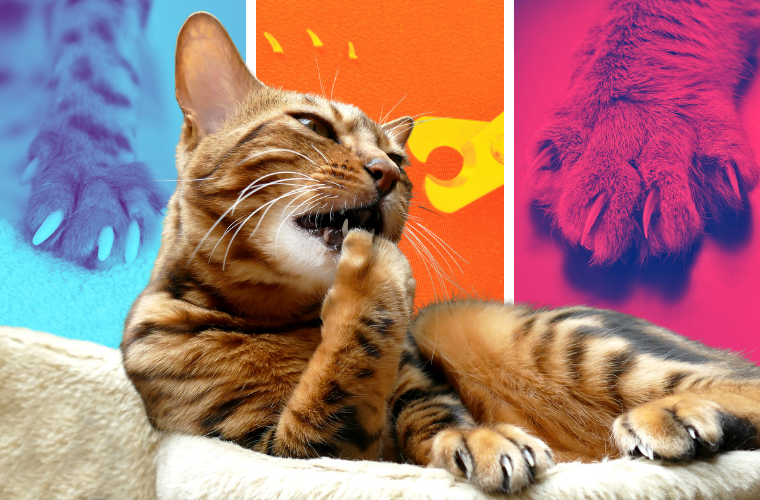
Images from Canva
Declawing has remained a controversial topic among veterinarians, animal advocates, and cat guardians, but the fact remains that it isn’t a simple procedure that merely removes a cat’s nails. Rather, the procedure, which is formally known as an onychectomy, involves surgically removing the last bone in a cat’s toe to which the nail is attached.
What is declawing?
The most common declawing procedure, formally known as onychectomy, is more than just taking off nails; it's a major surgery that involves removing a cat’s third toe bones and nails to which they are attached. It’s an amputation that's considered to be the equivalent of cutting off human fingers at the last joint.
Also controversial is a deep digital flexor tendonectomy, which is a surgical procedure that cuts the tendon in a cat's toe to permanently keep claws retracted.
Why are cats declawed?
The majority of cats are declawed over concerns about their scratching behaviors, which are a cat's natural way of marking territory, maintaining their nails, and stretching. It’s something they need to do.
In some cases, it’s justified by claiming it’s necessary to protect medically vulnerable guardians from being scratched. However, even the Centers for Disease Control does not recommend declawing; instead, it supports alternatives such as avoiding rough play, keeping cats indoors, and washing hands after handling cats.
Is it cruel to declaw cats?
Unequivocally, yes.
How does declawing affect cats?
For a digitigrade, or an animal who literally walks on their toes, declawing poses serious welfare concerns.
Much research on declawed cats has focused on issues following surgery, but a study published in the Journal of Feline Medicine and Surgery found some major problems. Researchers examined an equal number of declawed and non-declawed cats and their medical histories, and found that avoiding the litter box, biting, aggression, and excessive grooming occurred significantly more often in the declawed cats than the non-declawed cats.
Declawed cats were also more likely to be diagnosed with back pain, which is believed to be caused by chronic pain in their paws, which causes them to shift their weight, and shortening of their joints, which also alters the way they bear their weight.
Even more troubling was the number of botched surgeries that had left behind P3 fragments, or bone that should have been removed, inside the paws of declawed cats.
A subsequent study also found persistent post-operative pain in declawed cats, who exhibited “lameness, back pain, inappropriate elimination habits, licking and chewing at the digits, aversion to the feet being touched, and altered weight-bearing” among other signs that lead to suffering and a reduced quality of life.
A more recent study published in Scientific Reports also provided “robust evidence that declawing has chronic, deleterious effects on feline welfare and supports a universal ban on this convenience-based surgery.”
Last year, yet another study published in Nature concluded that declawed cats suffer more pain than cats with arthritis, had worse mobility and sensitivity to touch, and showed signs of chronic pain. Declawed cats also experienced greater functional impairment, and pain was persistent even years after surgery.
Overall, the research into declawing consistently shows how detrimental this procedure is for cats’ well-being, with many researchers pointing to the need to use the science to push to ban it.
Doesn’t declawing cats keep them out of shelters?
Some argue declawing helps keep cats in homes, but declawed cats still end up in shelters, and the additional medical and behavioral problems they may have, such as biting or refusing to use the litter box, can make them even harder to place. It's also impossible to know how a cat will react to this surgery beforehand.
Following a ban on declawing in British Columbia, the BC SPCA collaborated with researchers to study this claim, analyzing six years of data with records from 74,587 cats and found a decrease in the number of cats entering the shelter and a decrease in euthanasia. They also found cats spent less time waiting to be adopted than before, and there was no significant difference in surrenders for destructive scratching.
What are alternatives to declawing?
Fortunately, there are a number of humane alternatives to declawing available that will benefit everyone, including behavioral training and providing a variety of materials for them to scratch that are made of different things, such as sisal rope, cardboard or wood, and place them at different angles (some cats may prefer vertical items and others horizontal), and near items they’ve taken a liking to scratching. Also make sure they’re stable and long enough for your cat to stretch as far as they can. Some creativity and experimenting may be needed to find what they like, because they obviously have preferences just like us.
When you’re doing this, it’s best to remove access to items they’ve been scratching on, and encourage them to use scratchers you’ve provided. They may need time to figure it out, but should never be punished for doing what comes naturally to them. If they need some help, pick them up when they’re scratching something they shouldn’t and move them to the scratcher and give them a reward.
They can also be discouraged from using certain surfaces with double-sided sticky tape, while nail trimming or using nail caps, covering furniture, using deterrent sprays, or just simply keeping them out of certain rooms can also work.
Where is declawing illegal in the U.S.?
Growing opposition to declawing has led to a number of states banning the procedure, unless it’s done to treat an underlying medical condition, including New York, California, Maryland, Virginia, Massachusetts, Rhode Island, and the District of Columbia.
A number of cities have also implemented bans, and legislation is pending in even more states. In January 2026, Rep. Jerrold Nadler also introduced a resolution in Congress opposing elective cat declawing.
The procedure is also opposed by a number of organizations, including the American Association of Feline Practitioners, Humane Society Veterinary Medical Association, American Animal Hospital Association, National Animal Care and Control Association, Feline Veterinary Medical Association, and the International Society of Feline Medicine.
How You Can Help
Please support compassionate and ethical veterinarians who put their patients first by refusing to perform mutilating procedures on them, like declawing and devocalization.
You can find a list of veterinarians in the U.S. and Canada who refuse to declaw at the Paw Project.
Please also check our Animal Companions campaign and sign up for our latest news to be alerted about legislation that could ban declawing in your state.
Posted on All-Creatures.org: September 5, 2026
Return to Companion Animal Care
Follow us on:


- Home Page
- What's New
- Contact Us
- Action Alerts
- Animal Exploitation
- Animal Issues
- Animal Rights Activism
- Archives
- Art & Photography
- Articles Directory
- Bible
- Bible Commentary Blog
- Books
- Campaigns
- Church & Religion
- Discussions
- Events / Podcasts / Media
- Health
- Hosted Web Sites
- Humor
- Kids' Korner
- Letters
- Links
- Nature Studies
- Newsletter
- Poetry & Stories
- Prayers
- Quotations
- Recipes with Photos
- Recipes Without Photos
- Sermons
- Stop Cruelty in Churches
- Video Library
- The Mary T. and Frank L. Hoffman Family Foundation
- Email: [email protected]
A web site sponsored by The Mary T. and Frank L. Hoffman Family Foundation and all-creatures.org
Copyright © 1998-2026 The Mary T. and Frank L. Hoffman Family Foundation. All rights reserved. May be copied only for personal use or by not-for-profit organizations to promote compassionate and responsible living. All copied and reprinted material must contain proper credits and web site link www.all-creatures.org.
Fair Use Notice: This document, and others on our web site, may contain copyrighted material whose use has not been specifically authorized by the copyright owners. We believe that this not-for-profit, educational use on the Web constitutes a fair use of the copyrighted material (as provided for in section 107 of the US Copyright Law). If you wish to use this copyrighted material for purposes of your own that go beyond fair use, you must obtain permission from the copyright owner.

Thank you for visiting all-creatures.org.