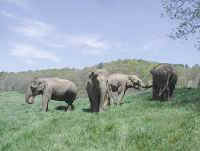
 Elephant Exploitation
An Animal Exploitation Photo Journal and Gallery Presentation from All-Creatures.org
This all creatures animal exploitation photo gallery about elephants is being presented to show the public the difference between the cute animals we see in advertising and picture in our minds and the reality that exists in the world.
Elephant Exploitation
Table of Contents
Wishful Thinking


Reality
| Entertainment | Ivory | Labor | Zoos |
Entertainment

(Elephant Exploitation - Entertainment - 01) Hawthorn Corporation's performing elephants
are chained by a leg in the barn. This is a form of continual abuse.
Boycott all animal acts. Do not attend their performances.

(Elephant Exploitation - Entertainment - 02) Lota chained in her barn at Hawthorn.
Dangerously underweight and tuberculosis exposed, Lota and Misty will be
required to live in quarantine after their rescue. Their release was
scheduled for August 15, 2004, but due to pending motions filed by John
Cuneo of the Hawthorn Corp., their rescue is delayed. She had been chained
and abused for about 48 years of her life after being kidnapped from her mother and family.

(Elephant Exploitation - Entertainment - 03) "On Aug. 20, 1994, Tyke ran amok in the
streets of Kaka'ako after mauling her groomer and killing her circus trainer
in Blaisdell Arena." It's not so much that Tyke "ran amok," as the
newspaper report stated, but that she came to that point in her life when
she could no longer stand the years of abuse. This tragedy never would
have occurred if humans didn't abuse animals for their own entertainment.

(Elephant Exploitation - Entertainment - 04) April 23, 2002: Delhi, another Hawthorn
Corporation elephant, had severe tissue damage to her front feet and several
abscessed areas on her body, including areas on both hips, between her eyes,
the anterior portion of her ear attachment, on her head, the elbows of both
front legs, and her tail. Chemical burns on Delhi's feet were the result of
the use of undiluted formaldehyde to soak Delhi's feet. When people attend
traveling animal acts, they contribute to these atrocities.

(Elephant Exploitation - Entertainment - 05)
I just wanted to share with you; This is Delhi, my heart!
...and this is what the circus does to an elephant's feet.

(Elephant Exploitation - Entertainment - 06) This is another photo of Delhi...and the new
life a true sanctuary brings. The chance to lie down and have her first toys in 55 years.

(Elephant Exploitation - Entertainment - 07)
The following pictures were taken from The Elephant Sanctuary:
Again this is Delhi; before and after. Note the horrific swelling of her right front leg.

(Elephant Exploitation - Entertainment - 08) These elephants are chained by their legs
and forced to stand on the hard concrete surface.

(Elephant Exploitation - Entertainment - 09) Note the bull hook that the "trainer" is
using to force this elephant to walk through city streets.

(Elephant Exploitation - Entertainment - 10) This so-called "trainer" was caught on film
beating a circus elephant into submission. Every time a person pays
admission to see an animal act, they are supporting this kind of cruelty.

(Elephant Exploitation - Entertainment - 11) We do not know the exact reason that this
elephant collapsed against the vehicles, but it is obvious that something is
terribly wrong. Note the cruel bull hook and whip being carried by the "trainer".

(Elephant Exploitation - Entertainment - 12) The highlighted portion of this photo shows
the injury caused by the cruel treatment these circus elephants are forced to endure.

(Elephant Exploitation - Entertainment - 13) This elephant collapsed and died while in
transit for a circus. Now her body is being dragged from this trailer
with a chain. This would not have happened if the elephants were
treated with love and respect and not moved about as objects of entertainment.

(Elephant Exploitation - Entertainment - 14)
Baby elephants are captured rodeo-style, roped around all four legs,
tethered neck-to-neck to an “anchor” elephant, and dragged from their
mothers. From this point forward in their lives, every moment, every
instinct, and every natural behavior is subjected to suppression and
discipline at the whim of the trainer. This and the eight images below were
all taken by a former Ringling Bros. employee at Ringling Bros. Center for
Elephant Conservation program.

(Elephant Exploitation - Entertainment - 15)
“Training” at Ringling’s breeding center. You may have wondered how Ringling
Bros. gets 8,000-pound elephants to perform tricks like sitting up and even
standing on their heads, but now you know. Ringling breaks the spirit of
elephants when they are vulnerable babies who should still be with their
mothers. The violent training sessions include using ropes, bullhooks, and
electric shock prods.

(Elephant Exploitation - Entertainment - 16) Six
full-grown men strain to keep a baby elephant on the ground. More training
for more tricks to entertain adults who continue to bring their children to
the circus to “learn about animals.”

(Elephant Exploitation - Entertainment - 17) And
yet another example of Ringling’s Center for Elephant Conservation that is
actually a torture camp for training traumatized baby elephants to perform
ridiculous tricks. The ropes, the tethers, the tie-downs are as blatantly
obvious as the bullhook.

(Elephant Exploitation - Entertainment - 18) This
baby elephant is being trained to sit on a tub. Ringling falsely claims that
the tricks are an extension of an elephant’s natural behavior and that they
use only voice commands and rewards to get the animals to learn a set
routine. In reality, the training tools are a terrifying combination of
ropes, chains, bullhooks, electrical shock devices, denial of material
protection and corporal punishment. Look in the eyes!

(Elephant Exploitation - Entertainment - 19) “They
scream and cry and struggle as they are stretched out, slammed to the
ground, gouged with bullhooks and shocked with electric prods” Sammy
Haddock, former baby elephant trainer for Ringling Bros. who took these
photos and gave them to PETA.

(Elephant Exploitation - Entertainment - 20) This
is a session to train the elephant to “lay down” on command. Bullhooks
abound. This barbaric and violent training process goes on in secret, out of
the public’s view, completely unmonitored by any federal, state or local law enforcement agency.

(Elephant Exploitation - Entertainment - 21) Three
bullhooks are used simultaneously on one elephant to force a headstand. Two
handlers are using a bullhook on each hind foot while Gary Jacobson uses a
bull hook to apply pressure to the back of the head. A rope is affixed to
the elephant’s trunk to keep it pulled under and between the front legs.

(Elephant Exploitation - Entertainment - 22) Gary
Jacobson uses a bullhook to force the elephant’s trunk up for some trick.

(Elephant Exploitation - Entertainment - 23) Bullhook.
This is the tool used to bruise, maim, control, “train” elephants. Swung
like a baseball bat, it can inflict horrific pain and injury. Used slowly to
dig into tender flesh, it can also inflict horrific pain and injury.
Training is about getting a desired result by any means possible. The
bullhook is always visible whenever elephants are “performing.”

(Elephant Exploitation - Entertainment - 24) Bullhook.
Seeing the solid steel structure explains how effective a tool this can be
to get an elephant to succumb to humans and do tricks out of absolute fear.
Ivory

(Elephant Exploitation - Ivory - 01) "Born Free CEO Will Travers (pictured with an
elephant carcass)." This elephant was killed for his or her
ivory tusks. This is an example of evilness and greed of some human
beings. People who buy ivory are buying it with the blood of elephants
just like this one, and they become a co-conspirator in the murder of these innocent beings.

(Elephant Exploitation - Ivory - 02) These tusks are being burned in an attempt to stop
the poaching of elephants for their ivory. The process involved in
procuring ivory is indeed horrific. The elephant must be killed before the
ivory can be procured - stoning, poison dart resulting in slow painful death
or machine gun slaughter of entire herds at waterholes. Regardless of the
mode in which the elephants are killed, the process of extracting the ivory
is all the same. In order to obtain all the ivory from the elephant, the
hunter and poacher must cut into the head because approximately 25% of the
ivory is contained in the head. What is then left on the fields of the
African or Asian plains is the corpse of a tusk less elephant with a
mutilated face and head.

(Elephant Exploitation - Ivory - 03) Illegal Domestic Ivory Trade - Worthless trinkets.
An eight-month HSUS investigation has uncovered a thriving market for
illegally traded elephant ivory in an unexpected place: the United States, a
nation that prides itself on the protection of endangered species and
vigilance in enforcing the ban on international ivory trade. Do not be
involved in the murder of elephants. Don't buy ivory!

(Elephant Exploitation - Ivory - 04) This vicious slaughter must end!! I've cried an
ocean of tears, I have no words.

(Elephant Exploitation - Ivory - 05) 166 elephants murdered! A Taiwanese customs
official measures the length of an elephant tusk along with hundreds of
other smuggled tusks from Cameroon. A total of 332 tusks weighing 2,160
kilograms were found in May, 2000 near the northern Keelung port in the
largest haul seized by local customs authorities.

(Elephant Exploitation - Ivory - 06) The Orphans: Every piece of ivory is a haunting
memory of a once proud and majestic animal that should have lived three
score years and ten; who has loved and been loved, and was once a member of
a close knit and loving family akin to our own, but who has suffered and
died to yield a tusk for a trinket.

(Elephant Exploitation - Ivory - 07) The Orphans: Every elephant that dies leaves family
and loved ones that have grieved deeply, the dependent young doomed to die
an agonizing death in terror and lonely isolation.

(Elephant Exploitation - Ivory - 08) The Orphans: Every person that buys ivory has blood
on their hands and is an accomplice in killing an elephant, causing immeasurable sorrow and suffering.

(Elephant Exploitation - Ivory - 09)
The Orphans: Orphaned babies; the greater number, a result of ivory poaching.

(Elephant Exploitation - Ivory - 10)
The Orphans: Elephant babies still possess the capacity to show love and affection to humans. God Bless these nursery
workers, who return those feelings to these fragile babies. A true orphanage.

(Elephant Exploitation - Ivory - 11)
The Orphans: So precious, they find comfort in each others company.

(Elephant Exploitation - Ivory - 12)
The Orphans: Like human children, play behavior is demonstrated in all animals of higher intelligence.

(Elephant Exploitation - Ivory - 13) The Orphans: These orphans are violently separated
from their mothers long before they are weaned. They need milk to survive
and their new "Moms" try to make up for the tragic loss. They are the angels.

(Elephant Exploitation - Ivory - 14)
The Orphans: How does the human heart possess the capacity to destroy creatures as fragile as these?

(Elephant Exploitation - Ivory - 15)
Notice some of the smaller tusks.... "Thai customs officials
show seized ivory in Bangkok on September 30, 2004. The ivory was seized on
September 16, from a Thai Airways International flight from Singapore bound
for Bangkok. Elephant is on the 'Ten Most Wanted Species' - most at risk
from unregulated international trade and their fate will be at issue at the
13th Convention on International Trade in Endangered Species (CITES).
conference starting this Saturday in Bangkok." REUTERS/Sukree Sukplang

(Elephant Exploitation - Ivory - 16)
This elephant mother was shot and killed by
poachers, leaving her six month old child an orphan. Human greed knows no mercy.
(Elephant Exploitation - Ivory - 17)
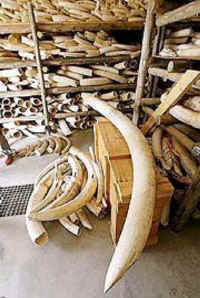
Hundreds of elephants were brutally murdered for
these tusks. We need to remember that the basic characteristics of sin
in the world are the human lust of the eye, the lust of the flesh, and the
boastful pride of life. To trade in the tortured body parts of another
living being fulfills two of these sinful traits: they lust over the
"beauty" of the ivory, and because it has material value, they boast over
possessing it.
Labor

(Elephant Exploitation - Labor - 01)
The wounds on this elephant's trunk were caused by the indiscriminate use of
the Ankus (bull hook) at a temple in Bangalore. Caught in the wild, taken
from their mothers, baby elephants are punished until they "succumb" to
human domination. Then they are used by humans as slave labor, with constant
reminders of who's in charge...the humans.

(Elephant Exploitation - Labor - 02) A mahout (elephant trainer) uses a
sharp stick to jab the elephant in the mouth. Since the elephant had refused
to move in the direction the mahout wanted, a quick jab in the soft tissue
of the elephant's mouth was "necessary" to force the elephant to move.
Zoos

(Elephant Exploitation - Zoo - 01)
This is Lulu, the San Francisco Zoo's lone African
elephant in her barren enclosure. No enrichment but an old tire, no grass,
no greenery. Alone since the death of her companion over the summer.
The elephants that are forced to live alone is contrary to American
Zoological and Aquarium Association's own guidelines and standards of care,
and so by their own definition, abuse.

(Elephant Exploitation - Zoo - 02)
This is Tinkerbelle, the San Francisco Zoo's Asian
elephant. She is also alone in her enclosure, due to the euthanization of
her companion within weeks of the death of Lulu's companion. Again, her
surroundings are barren and completely mind-numbing, no greenery other than
ornamental. A couple of bamboo branches and 2 hanging toys are her
enrichment, her only company. Elephants mourn the loss of their companions
and loved ones just as we do.

(Elephant Exploitation - Zoo - 03)
Tinkerbelle appears to have been given inadequate foot
care, which is necessary for captive elephants because of their lack of
walking exercise in the wild.

(Elephant Exploitation - Zoo - 04)
Tinkerbelle also appears to have pressure scaring on her back.

(Elephant Exploitation - Zoo - 05)
This is a photo of the open sores on the right side of Tinkerbelle's face.

(Elephant Exploitation - Zoo - 06) This is a photo of the open sores on the left side of
Tinkerbelle's face.
See the following stories:
The Tragedy of "Burra", Orphaned by the Despicable Bushmeat Trade
The Nursery Welcomes Orphan "Mpala"
Little Morani is Learning How to Trust Humans Again
Nasalot the Orphaned Elephant
Mulika the Orphaned Elephant
What can I do?
Follow us on:


- Home Page
- What's New
- Contact Us
- Action Alerts
- Animal Exploitation
- Animal Issues
- Animal Rights Activism
- Archives
- Art & Photography
- Articles Directory
- Bible
- Bible Commentary Blog
- Books
- Campaigns
- Church & Religion
- Discussions
- Events / Podcasts / Media
- Health
- Hosted Web Sites
- Humor
- Kids' Korner
- Letters
- Links
- Nature Studies
- Newsletter
- Poetry & Stories
- Prayers
- Quotations
- Recipes with Photos
- Recipes Without Photos
- Sermons
- Stop Cruelty in Churches
- Video Library
- The Mary T. and Frank L. Hoffman Family Foundation
- Email: [email protected]
A web site sponsored by The Mary T. and Frank L. Hoffman Family Foundation and all-creatures.org
Copyright © 1998-2026 The Mary T. and Frank L. Hoffman Family Foundation. All rights reserved. May be copied only for personal use or by not-for-profit organizations to promote compassionate and responsible living. All copied and reprinted material must contain proper credits and web site link www.all-creatures.org.
Fair Use Notice: This document, and others on our web site, may contain copyrighted material whose use has not been specifically authorized by the copyright owners. We believe that this not-for-profit, educational use on the Web constitutes a fair use of the copyrighted material (as provided for in section 107 of the US Copyright Law). If you wish to use this copyrighted material for purposes of your own that go beyond fair use, you must obtain permission from the copyright owner.
Thank you for visiting all-creatures.org.
Since 