How to
Minimize Aluminum Exposure:
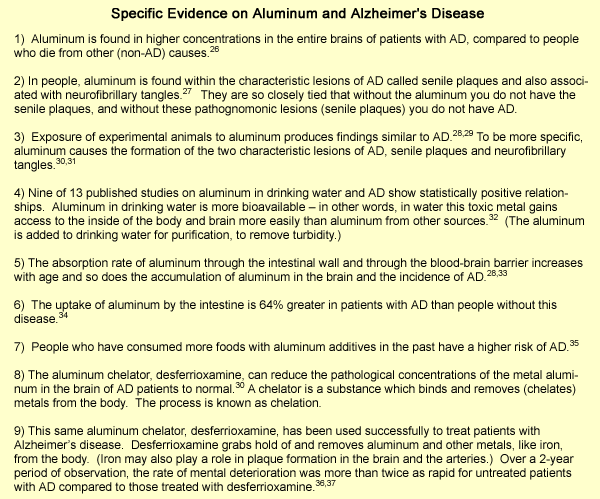
Aluminum Is in Our Foods38
Aluminum is the
most abundant metal in the earth’s crust and the third most abundant
element, behind oxygen and silicon. Aluminum is present in our water,
foods, medications, and air. The healthy human body has effective
barriers, such as the skin, lungs, and gastrointestinal tract, against
aluminum. Aluminum is not a nutrient – in other words, the body has no
need for this metal – and avoidance has no negative consequences.
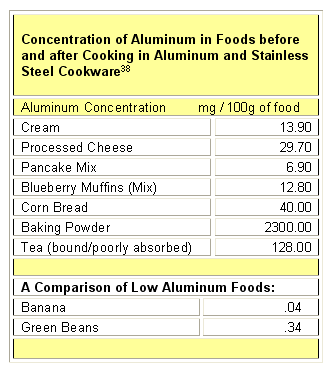
All foods
naturally contain aluminum, but some, such as tea, are particularly high
in this metal. Fortunately, most of the aluminum in natural plant foods is
bound with other substances, such as silicon, which prevents absorption of
the aluminum into the body. The harmful (unbound, more easily
absorbable) forms of aluminum enter our foods as additives, such as a
leavening agent, emulsifier, acidifying agent, anti-caking agent, or
coloring. Cooking, packaging and handling foods in aluminum containers
increase the amount of this toxic metal in foods.
The cans used for carbonated and non-carbonated beverages,
like colas and fruit drinks, leak significant amounts of aluminum into the
beverage.39 Most canned-food containers, however, are made of
steel, not aluminum. The use of aluminum skillets, pressure cookers, pans,
pots, coffee makers, dinner trays, wraps and foils all add aluminum to
foods. Long cooking in an acidic environment, and using new pots and
pans, further increases aluminum leaching into the food. For example,
tomato products provide an acidic environment during cooking – using an
aluminum pot to simmer tomato sauce increases the aluminum concentration
by 570 times.38

Avoid
Medications Containing Aluminum
Look at the
labels of your over-the-counter medications. You will find aluminum as an
active ingredient in many antacids. People may be consuming 840 to 5000
mg of aluminum a day from this source.38 Pain killers
(analgesics) often have aluminum as an inactive ingredient (130 to 730
mg/day can be consumed).38 Some calcium supplements contain
small amounts of aluminum. Also look up your prescription medications on
the Internet or in a PDR (Physician’s Desk Reference), and you will often
find aluminum used as an inactive ingredient.
Taking Citracal©
(calcium citrate antacids) increases aluminum absorption into the body by
8 to 11 times over the absorption that would occur when aluminum is
present in the intestine without citrate.40-42 Many liquid and
wafer antacids do not contain citrate, such as TUMS with calcium
carbonate.
In the
United States, aluminum potassium sulfate is the only approved substance
used to enhance the immune response and approved for use in vaccines.
Some researchers consider this a serious matter and suspect that the
amounts given during routine vaccination can cause an ongoing inflammatory
response in the brain.43
Aluminum from
the Air
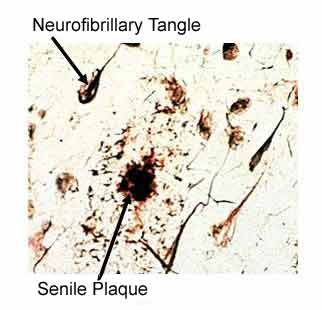
In AD there has
been a tendency for some of the greatest accumulation of plaques and
neurofibrillary tangles to occur in the olfactory lobes of the brain.44
This is the only portion of the brain that has direct exposure to the
outside environment, through the nose. Here the smell-sensitive nervous
tissues have the capacity to pick up and transmit substances like aluminum
directly into the brain.44,45 In the past, most of the
airborne aluminum came from industrial sources.
There is now a
new and common source of airborne aluminum and that is from
antiperspirants. Every morning people are spraying past their armpits
right into their faces with these products. One study found a 60% greater
risk of AD with use of antiperspirants, and a trend toward a higher risk
with increasing frequency of use.46 All antiperspirants
contain aluminum chloride – which stops the sweating. Plain
deodorants do not contain this aluminum ingredient.
McDougall’s
Recommendations for the Prevention and Treatment of Alzheimer’s Disease
Fortunately, the
recommendations for AD are the same ones that I would offer for the
prevention and treatment for most of the other common diseases which
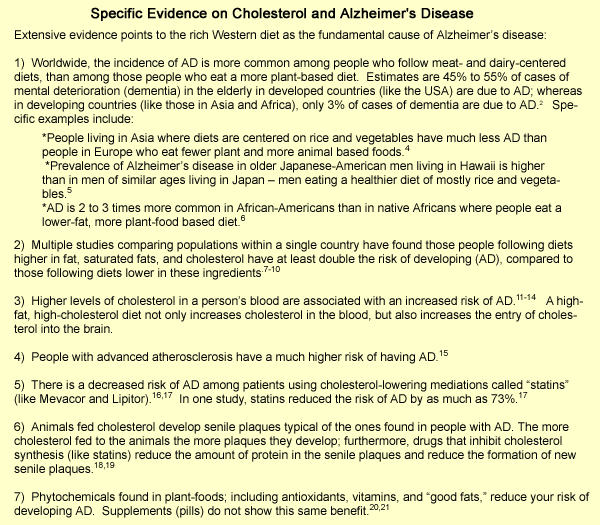
plague people who follow the rich Western diet: Consume a low-fat,
no-cholesterol, plant-based diet and avoid toxic substances -- the focus
in this case is aluminum, but iron may also be important. There is
absolutely no reason to delay following this advice – the benefits are
documented for many diseases and for health in general.
Your goals should
be similar to the ones you already know for heart disease. For example,
you should strive for a blood total cholesterol level below 150 mg/dl.
You accomplish this, first and foremost, by following a no-cholesterol,
low-fat diet based on plant foods (The McDougall Diet). Depending upon
the degree of impending risk for future trouble (for example heart
disease, stroke, or AD) you may decide to add cholesterol-lowering
medications in order to accomplish this goal. (See my September 2002
Newsletter article, “Cholesterol - When and How to Treat.”)
Someone
suffering with AD should be even more aggressive with treating cholesterol
and removing toxic aluminum from the body. In this case I would be more
inclined to prescribe statin medications, with a goal of achieving a
cholesterol level below 150 mg/dl. (See my June 2003 Newsletter article,
“Cleaning out Your Arteries,” for a relevant discussion on treating artery
disease and a guide to AD treatment.) There is an argument that the kind
of medication matters – statins which do not easily cross the blood-brain
barrier (like Lipitor does not easily cross) should be used.47
Next, for someone
with AD I would administer desferrioxamine, 125 mg intramuscularly
twice daily for 5 days per week for months and maybe years, in order to
remove aluminum and iron from the body.36,37 Although daily
injections may seem painful, they do not approach the suffering from the
progressive loss of mental function of AD. (By the way, desferrioxamine is
a low-profit drug that cannot be patented and this is the reason you have
not heard about this treatment. This all may change for drug treatments
for AD when high profit statins are recommended, and advertised to
patients and doctors.)
So you see
you are no more helpless with AD then you are with CHD (coronary heart
disease). Your options are mostly limited by what you know. Since money
drives information, too few people know about these simple,
scientifically-based steps I have outlined to avoid the suffering of AD
and other common diseases.
References:
1) Reilly JF,
Games D, Rydel RE, Freedman S, Schenk D, Young WG, Morrison JH, Bloom
FE. Amyloid deposition in the hippocampus and entorhinal cortex:
quantitative analysis of a transgenic mouse model. Proc Natl Acad Sci
U S A. 2003 Apr 15;100(8):4837-42.
2) Kalaria RN.
Comparison between Alzheimer's disease and vascular dementia: implications
for treatment. Neurol Res. 2003 Sep;25(6):661-4.
3) Mucchiano GI,
Haggqvist B, Sletten K, Westermark P. Apolipoprotein A-1-derived amyloid
in atherosclerotic plaques of the human aorta. J Pathol. 2001
Feb;193(2):270-5.
4) Jorm AF,
Jolley D. The incidence of dementia: a meta-analysis.
Neurology. 1998 Sep;51(3):728-33.
5) White L,
Petrovitch H, Ross GW, Masaki KH, Abbott RD, Teng EL, Rodriguez BL,
Blanchette PL, Havlik RJ, Wergowske G, Chiu D, Foley DJ, Murdaugh C, Curb
JD. Prevalence of dementia in older Japanese-American men in Hawaii: The
Honolulu-Asia Aging Study. JAMA. 1996 Sep 25;276(12):955-60.
6) Hendrie HC,
Osuntokun BO, Hall KS, Ogunniyi AO, Hui SL, Unverzagt FW, Gureje O,
Rodenberg CA, Baiyewu O, Musick BS. Prevalence of Alzheimer's disease and
dementia in two communities: Nigerian Africans and African Americans.
Am J Psychiatry. 1995 Oct;152(10):1485-92.
7) Morris MC,
Evans DA, Bienias JL, Tangney CC, Bennett DA, Aggarwal N, Schneider J,
Wilson RS. Dietary fats and the risk of incident Alzheimer disease.
Arch Neurol. 2003 Feb;60(2):194-200.
8) Kalmijn S,
Feskens EJ, Launer LJ, Kromhout D. Polyunsaturated fatty acids,
antioxidants, and cognitive function in very old men. Am J Epidemiol.
1997 Jan 1;145(1):33-41.
9) Luchsinger
JA, Tang MX, Shea S, Mayeux R.Caloric intake and the risk of Alzheimer
disease. Arch Neurol. 2002 Aug;59(8):1258-63.
10) Engelhart MJ,
Geerlings MI, Ruitenberg A, Van Swieten JC, Hofman A, Witteman JC,
Breteler MM. Diet and risk of dementia: Does fat matter?: The Rotterdam
Study. Neurology. 2002 Dec 24;59(12):1915-21.
11) Notkola IL,
Sulkava R, Pekkanen J, Erkinjuntti T, Ehnholm C, Kivinen P, Tuomilehto J,
Nissinen A. Serum total cholesterol, apolipoprotein E epsilon 4 allele,
and Alzheimer's disease. Neuroepidemiology. 1998;17(1):14-20.
12) Kivipelto M,
Helkala EL, Laakso MP, Hanninen T, Hallikainen M, Alhainen K, Soininen H,
Tuomilehto J, Nissinen A. Midlife vascular risk factors and Alzheimer's
disease in later life: longitudinal, population based study. BMJ.
2001 Jun 16;322(7300):1447-51.
13) Jarvik GP,
Wijsman EM, Kukull WA, Schellenberg GD, Yu C, Larson EB. Interactions of
apolipoprotein E genotype, total cholesterol level, age, and sex in
prediction of Alzheimer's disease: a case-control study. Neurology.
1995 Jun;45(6):1092-6.
14) Kuo YM,
Emmerling MR, Bisgaier CL, Essenburg AD, Lampert HC, Drumm D, Roher AE.
Elevated low-density lipoprotein in Alzheimer's disease correlates with
brain abeta 1-42 levels. Biochem Biophys Res Commun. 1998 Nov
27;252(3):711-5.
15) Hofman A,
Ott A, Breteler MM, Bots ML, Slooter AJ, van Harskamp F, van Duijn CN, Van
Broeckhoven C, Grobbee DE. Atherosclerosis, apolipoprotein E, and
prevalence of dementia and Alzheimer's disease in the Rotterdam Study.
Lancet. 1997 Jan 18;349(9046):151-4.
16) Jick H,
Zornberg GL, Jick SS, Seshadri S, Drachman DA. Statins and the risk of
dementia. Lancet. 2000 Nov 11;356(9242):1627-31.
17) Wolozin B,
Kellman W, Ruosseau P, Celesia GG, Siegel G.Decreased prevalence of
Alzheimer disease associated with 3-hydroxy-3-methyglutaryl coenzyme A
reductase inhibitors. Arch Neurol. 2000 Oct;57(10):1439-43.
18) Fassbender
K, Simons M, Bergmann C, Stroick M, Lutjohann D, Keller P, Runz H, Kuhl S,
Bertsch T, von Bergmann K, Hennerici M, Beyreuther K, Hartmann
T.Simvastatin strongly reduces levels of Alzheimer's disease beta -amyloid
peptides Abeta 42 and Abeta 40 in vitro and in vivo. Proc Natl Acad
Sci U S A. 2001 May 8;98(10):5856-61.
19) Friedhoff
LT, Cullen EI, Geoghagen NS, Buxbaum JD. Treatment with
controlled-release lovastatin decreases serum concentrations of human
beta-amyloid (A beta) peptide. Int J Neuropsychopharmacol. 2001
Jun;4(2):127-30.
20) Foley DJ,
White LR. Dietary intake of antioxidants and risk of Alzheimer disease:
food for thought. JAMA. 2002 Jun 26;287(24):3261-3.
21) Engelhart MJ,
Geerlings MI, Ruitenberg A, van Swieten JC, Hofman A, Witteman JC,
Breteler MM. Engelhart Dietary intake of antioxidants and risk of
Alzheimer disease. JAMA. 2002 Jun 26;287(24):3223-9.
22) Sparks DL,
Lochhead J, Horstman D, Wagoner T, Martin T. Water quality has a
pronounced effect on cholesterol-induced accumulation of Alzheimer amyloid
beta (Abeta) in rabbit brain. J Alzheimers Dis. 2002
Dec;4(6):523-9.
23) Grant WB,
Campbell A, Itzhaki RF, Savory J. The significance of environmental
factors in the etiology of Alzheimer's disease. J Alzheimers Dis.
2002 Jun;4(3):179-89.
24) Campbell A,
Yang EY, Tsai-Turton M, Bondy SC. Pro-inflammatory effects of aluminum in
human glioblastoma cells. Brain Res. 2002 Apr 12;933(1):60-5.
25) Savory J,
Garruto RM. Aluminum, tau protein, and Alzheimer's disease: an important
link? Nutrition. 1998 Mar;14(3):313-4.
26) Crapper DR,
Krishnan SS, De Boni U, Tomko GJ. Aluminum: a possible neurotoxic agent
in Alzheimer's disease. Trans Am Neurol Assoc. 1975;100:154-6.
27) Candy JM,
Oakley AE, Klinowski J, Carpenter TA, Perry RH, Atack JR, Perry EK,
Blessed G, Fairbairn A, Edwardson JA. Aluminosilicates and senile plaque
formation in Alzheimer's disease. Lancet. 1986 Feb
15;1(8477):354-7.
28) Campbell A.
The potential role of aluminum in Alzheimer's disease. Nephrol Dial
Transplant. 2002;17 Suppl 2:17-20.
29) Zatta P,
Lucchini R, van Rensburg SJ, Taylor A. The role of metals in
neurodegenerative processes: aluminum, manganese, and zinc. Brain Res
Bull. 2003 Nov 15;62(1):15-28.
30) Shin RW,
Kruck TP, Murayama H, Kitamoto T. A novel trivalent cation chelator
Feralex dissociates binding of aluminum and iron associated with
hyperphosphorylated tau of Alzheimer's disease. Brain Res. 2003
Jan 24;961(1):139-46.
31) Kawahara M,
Kato M, Kuroda Y. Effects of aluminum on the neurotoxicity of primary
cultured neurons and on the aggregation of beta-amyloid protein. Brain
Res Bull. 2001 May 15;55(2):211-7.
32) Flaten TP..
Aluminum as a risk factor in Alzheimer's disease, with emphasis on
drinking water. Brain Res Bull. 2001 May 15;55(2):187-96.
33) Taylor GA, Ferrier IN, McLoughlin IJ,
Fairbairn AF, McKeith IG, Lett D, Edwardson JA. Gastrointestinal
absorption of aluminum in Alzheimer's disease: response to aluminum
citrate. Age Ageing. 1992 Mar;21(2):81-90.
34) Moore PB,
Day JP, Taylor GA, Ferrier IN, Fifield LK, Edwardson JA. Absorption of
aluminum-26 in Alzheimer's disease, measured using accelerator mass
spectrometry. Dement Geriatr Cogn Disord. 2000 Mar-Apr;11(2):66-9.
35) Rogers MA,
Simon DG. A preliminary study of dietary aluminum intake and risk of
Alzheimer's disease. Age Ageing. 1999 Mar;28(2):205-9.
36) McLachlan
DR, Dalton AJ, Kruck TP, Bell MY, Smith WL, Kalow W, Andrews DF.
Intramuscular desferrioxamine in patients with Alzheimer's disease.
Lancet. 1991 Jun 1;337(8753):1304-8.
37) McLachlan
DR, Smith WL, Kruck TP. Desferrioxamine and Alzheimer's disease: video
home behavior assessment of clinical course and measures of brain
aluminum.
Ther Drug Monit. 1993 Dec;15(6):602-7.
38) Soni MG,
White SM, Flamm WG, Burdock GA. Safety evaluation of dietary aluminum.
Regul Toxicol Pharmacol. 2001 Feb;33(1):66-79.
39) Duggan JM,
Dickeson JE, Tynan PF, Houghton A, Flynn JE. Aluminum beverage cans as a
dietary source of aluminum. Med J Aust. 1992 May 4;156(9):604-5.
40) Nolan CR,
DeGoes JJ, Alfrey AC. Aluminum and lead absorption from dietary sources
in women ingesting calcium citrate. South Med J. 1994
Sep;87(9):894-8.
41) Coburn JW,
Mischel MG, Goodman WG, Salusky IB. Calcium citrate markedly enhances
aluminum absorption from aluminum hydroxide. Am J Kidney Dis. 1991
Jun;17(6):708-11.
42) Walker JA,
Sherman RA, Cody RP. The effect of oral bases on enteral aluminum
absorption. Arch Intern Med. 1990 Oct;150(10):2037-9.
43) Campbell A,
Becaria A, Lahiri DK, Sharman K, Bondy SC. Chronic exposure to aluminum
in drinking water increases inflammatory parameters selectively in the
brain. J Neurosci Res. 2004 Feb 15;75(4):565-72.
44) Perl DP,
Good PF. Aluminum, Alzheimer's disease, and the olfactory system.
Ann N Y Acad Sci. 1991;640:8-13.
45) Christen-Zaech
S, Kraftsik R, Pillevuit O, Kiraly M, Martins R, Khalili K, Miklossy J.
Early olfactory involvement in Alzheimer's disease. Can J Neurol Sci.
2003 Feb;30(1):20-5.
46) Graves AB,
White E, Koepsell TD, Reifler BV, van Belle G, Larson EB. The association
between aluminum-containing products and Alzheimer's disease.
J Clin Epidemiol. 1990;43(1):35-44.
47) Sparks DL,
Connor DJ, Browne PJ, Lopez JE, Sabbagh MN. HMG-CoA reductase inhibitors (statins)
in the treatment of Alzheimer's disease and why it would be ill-advise to
use one that crosses the blood-brain barrier. J Nutr Health Aging.
2002;6(5):324-31.
48) Puglielli L,
Tanzi RE, Kovacs DM. Alzheimer's disease: the cholesterol connection.
Nat Neurosci. 2003 Apr;6(4):345-51.
49) Ewbank DC.
Deaths attributable to Alzheimer's disease in the United States.
Am J Public Health. 1999 Jan;89(1):90-2.
50) CDC.
Mortality Trends for Alzheimer's
Disease, 1979-91
http://www.cdc.gov/nchs/products/pubs/pubd/series/sr20/pre-1/sr20_28.htm
51) No Authors.
From the Centers for Disease Control. Mortality from Alzheimer
disease--United States, 1979-1987. JAMA. 1991 Jan
16;265(3):313,317.
Fair Use Notice: This document may contain copyrighted material whose
use has not been specifically authorized by the copyright owners.
We believe that this not-for-profit, educational
use on the Web constitutes a fair use of the copyrighted material (as
provided for in section 107 of the US Copyright Law). If you wish to use
this copyrighted material for purposes of your own that go beyond fair
use, you must obtain permission from the copyright owner.