 Nuts and Seeds -
Ingredients Descriptions and Photos
Nuts and Seeds -
Ingredients Descriptions and Photos
From All-Creatures.org Vegan - Vegetarian Recipe Book: How Mary and Frank and Friends Eat
"We are dedicated to cruelty-free living through a vegetarian - vegan lifestyle. Let no animal suffer or die that we may live!"
Ingredients Descriptions and Photos
Nuts and Seeds
Table of Contents

(Almonds)
Almonds grow on a medium sized tree that is related to the peach, and like the
peach, the almond tree produces beautiful pink or pinkish-white flowers.
The almond tree is native to the Mediterranean, but it is now grown commercially
in other areas of the world, such as California. Almonds have a high
nutritional ratio to calories when compared to other nuts, but like all nuts,
they are high in calories. See nutritional chart by clicking on the photo or link.
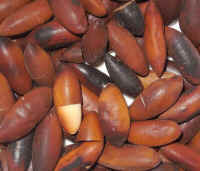
(Baru Nuts) Baru nuts come from the baru
tree (Dipteryx alata Vog.) which grow in the savanna ecoregion of Brazil
known as the “Cerrado”. They are said to have a taste like a mixture of
peanuts and cashews, which the eater much deside for themselves. Baru nuts
are wild-collected in the Cerrado by a local coop of organized families and
this work has been promoting great socio-environmental aid to the region.
With the growing consumption of baru nuts, its trees are no longer being cut
down for timber since maintaining them standing is now valuable and
sustainable, thus preserving the original flora & wildlife and creating much
needed jobs for the local communities. The impact of these actions are
helping to save this important and amazing ecosystem. Every 100 grams of
Baru nuts contain: 40 grams of fat, 24 grams of protein, 26.3 grams of
fiber (100% of daily requirement), 21.4 mg of Vitamin E (100% of daily
requirement), 6.7 mg of Zinc, 2.6 mg of Iron, 150 mg of Calcium, 228 mg of
Magnesium, 1575 mg of Potassium, but this amount of nuts also contain 533
calories.

(Brazil Nuts) The towering Brazil nut tree was originally discovered growing
in hard, well-drained land along the Amazon River in South America. The
Brazil nut tree produces a large round or pear-shaped fruit with an outer skin,
a hard outer shell, and a core containing twelve to twenty Brazil nuts.
Brazil nuts are hard to crack open and to retain the whole nuts (as pictured),
as the nut usually breaks up with the shell. We have found that the best
way to open Brazil nuts is to place them in the freezer. When frozen, the
nuts crack open easily, retaining the whole inner nut kernel. See
nutritional chart by clicking on the photo or link.
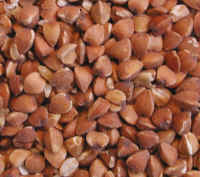
(Buckwheat)
The origin of buckwheat is believed to be central and western China. Many people
think that buckwheat is a cereal grain, but it is actually a fruit seed that is
related to rhubarb and sorrel making it a suitable substitute for grains for
people who are sensitive to wheat or other grains that contain protein glutens.
Buckwheat is also highly nutritious, as can be seen in the nutritional chart.
Roasted buckwheat groats are called kasha. Whole buckwheat can be used as
a substitute for rice and cooked as a cereal. Buckwheat flour can be used in
making oven cakes, pancakes, and breads. To enlarge the photo and see the
nutritional chart, click on the photo or link.
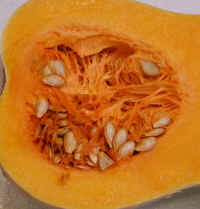
(Butternut Squash Seeds)
This is a photo of the seed cavity of a butternut squash
that has been cut in half, lengthwise. We like to scoop out the seeds and
roast the whole seed for a snack. See our recipe for
toasted squash seeds. Squash seeds
are a good source of calcium and zinc. The nutritional chart is roasted
whole seeds, which can be seen by clicking on the photo or link. The only
nutritional data we could find was for roasted pumpkin and squash seeds
considered together.

(Caraway Seeds) Caraway is
probably most often recognized as the seeds in rye bread, but it is also used in
a number of other recipes, such as soups, casseroles, curries, and even liquors,
because of its strong aromatic flavor. These much enlarged caraway seeds are in
a 1 tablespoon measure, and are in actuality only about 2 millimeters long. The
so-called seeds aren't really seeds, but the fruit of the 2 foot high Carum
carvi plant, a native of Asia, Europe, and North Africa. To enlarge the photo
and see the nutritional chart, click on the photo or link.
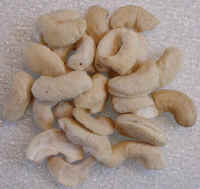
(Cashews)
The cashew tree is relatively small, usually not growing over twenty to thirty
feet in height. One nut grows on the end of a pear-shaped "apple".
The nut is then roasted in its shell to release a toxic substance. It is
then cracked open and the kernel (edible portion) removed and marketed.
See nutritional chart by clicking on the photo or link.

(Chestnuts)
The chestnut tree is related to the Beech tree and is a native of the
Northeastern United States. The commercial growing of chestnuts in the
United States was wiped out by a blight in the early 1900's. Today, most
of the commercially available chestnuts seem to be imported from Italy.
The fruit of the chestnut tree is prickly and contains two or three chestnuts;
the outermost ones are rounded to the outside of the cluster and flattened to
the inside. Chestnuts that are flat on both sides are the inner nut of a
"three cluster". We have found that store purchased chestnuts are
extremely prone to fungus (mold), especially later in the season. See
nutritional chart by clicking on the photo or link.
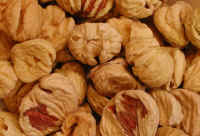
(Chestnuts, Dried) Dried and peeled chestnuts are sold in bulk in specialty food
stores and coops. They are an excellent way of having chestnuts all year
long, and when you are adding chestnuts to a recipe. Boiled
(reconstituted) chestnuts are also good to eat, and they are generally sweeter
than the roasted chestnuts in the shell. In recent years, we have found
that the quality of the chestnuts in the shell has been going down with many
being moldy; the dried chestnuts do not have this problem. When the dried
chestnuts are boiled, most of the dark brown husk that remains on the chestnuts
(see photo) will come off. To enlarge the photo and see the nutritional
chart click on the photo or link.
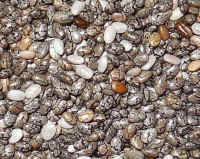
(Chia Seed) Chia seed, scientificly known
as Salvia hispanica, is a species of flowering plant in the mint family,
Lamiaceae, native to central and southern Mexico and Guatemala. It is
considered a pseudocereal. It is cultivated for its edible, hydrophilic chia
seed, a food rich in omega-3 fatty acids; howeven, chia seeds are much more
expensive than flax seeds, which are also rich in omega-3 fatty acids. The
actual size of the individual chia seeds are about 1 mm. in length. Chia seed is grown and commonly used as food in several
countries of western South America, western Mexico, and the southwestern United
States. To enlarge the photo and see the nutritional chart, click
on the photo or link.
(Coconut, Unsweetened Flaked) Flaked unsweetened coconut is made from dehydrated
coconut meat, which has been separated from the shell. We have not seen
flaked unsweetened coconut sold in supermarkets, but it is commonly sold in
health food stores and by coops. It is prone to becoming rancid, so we
only buy it in sealed containers and store it in our freezer. We use
unsweetened coconut mostly for flavoring of Asian recipes, desserts, and
smoothies. Unsweetened flaked coconut is very high in calories, with 80%
coming from fat. To enlarge the photo and see the nutritional chart, click
on the photo or link.
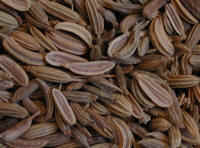
(Fennel Seeds) We use
fennel seeds mostly for flavoring in some of our recipes, particularly in pasta
sauce. It has a mild licorice or anise type odor, and is often mistaken
for anise. Actually, fennel seeds are not really seeds; They are actually the
fruit of the sweet fennel plant. This herb has been cultivated for culinary use
for thousands of years, and most cooks have referred to the fruit as “seeds”,
since they are small and usually sold in a dry form which looks exactly like a
seed. They are available in most supermarket seasoning sections or from
health food stores or coops. To see the nutritional chart click on the
photo or link.
Filberts (See Hazelnuts)

(Flaxseed, Dark) Flaxseed comes from the same plant from which we get linen.
The seed is very high in Omega-3 fatty acids, which are essential to good
health. The Omega-3 in flaxseed has been associated with reducing LDL
cholesterol, improving immune function, and reducing the risk of blood platelet
aggregation. The nutritional value of flaxseed is released only if the
seed is ground or crushed. We cannot digest the whole seed. Flaxseed
has a pleasant nutty flavor, and crushed seeds can be added to a salad.
The soluble fiber in flaxseed acts as a thickening and binding agent. We
add flaxseed to our fruit and vegetable smoothies. Flaxseed should be
stored in the freezer to preserve its freshness. See the nutritional chart
by clicking on the photo or link (we could not find any nutritional data that
distinguished between light and dark flaxseed).
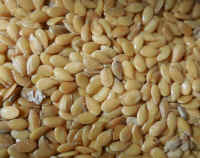
(Flaxseed, Golden) Flaxseed can also
be spelled or written, flax seed, or referred to as linseed, because the
plant fiber is used to make linen; all names are correct. In this enlarged
photo of golden flaxseed we can more easily see what they look like,
including a split seed on the left of the photo. Flax seeds are also the
most widely available botanical source of omega-3 fatty acids. We freeze our
raw golden flaxseeds to prevent them from spoiling, and add 3 heaping
tablespoons of the raw whole flax seeds in our blender container to make 2
quarts of fruit or green smoothies. According to the literature that we've
seen, golden flaxseed was developed for human consumption, because of its
nutty-buttery flavor. The nutritional value of golden flaxseed vs. dark or
brown flaxseed is very similar, which is confirmed by information printed on
product packaging. We could not find any comprehensive nutritional
information for raw golden flaxseed. (See the
general nutritional flaxseed information listed with dark flaxseed)
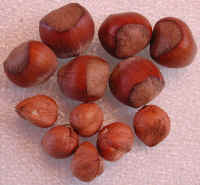
(Hazelnuts)
Hazelnuts grow in clusters on a shrub. The nuts are covered with a
prickly-haired husk, which can easily puncture the skin, but which the squirrels
seem to be most adept at penetrating. They are often used commercially in
candy and baked goods. See the nutritional chart by clicking on the photo or link.
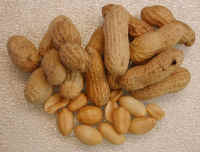
(Peanuts)
Peanuts are not really a nut, but an underground growing bean or pea, which led
to their being called "Goober's peas". Dry roasted peanuts are good
tasting, a fun food (especially when in the shell) and not a junk food; but they
are very high in calories because of their high oil content. The
nutritional chart, which can be seen by clicking on the photo or link, is for
the shelled nuts.
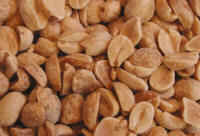
(Peanuts, Dry Roasted) We purchased some
unsalted dry roasted peanuts from our coop, and have also seen them in most
supermarkets selling for about one half the cost of natural peanut butter with
no additives. As a result, we have been experimenting with the use of dry
roasted peanuts in our recipes as a substitute for peanut butter, when it is
prepared in our Vita-Mix. By volume, the dry roasted peanuts are slightly over
one half the weight of peanut butter, so we use twice the volume of the amount
of peanut butter called for in the recipe. And, best of all, we found that it
has the exact same flavor and taste. The dry roasted peanuts can also be ground
in the Vita-Mix or a food processor to make smooth or chunky peanut butter. To
enlarge the photo and see the nutritional chart, click on the photo or link.
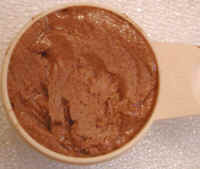
(Peanut Butter) We only purchase pure peanut butter with no other ingredients
added. This particular brand's label lists the only ingredient as:
organically grown, dry roasted, unblanched valencia peanuts. We use peanut
butter for sandwiches, sauces, and in making our vegan slushies and ice cream.
We could not find complete nutritional data for this type of peanut butter;
however, we suspect that it would be the same as that of peanuts, which has the
same fat, protein, and carbohydrate percentages according to the label. To
enlarge the photo and see the nutritional chart, click on the photo or link.
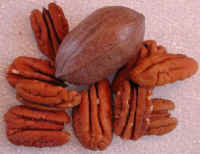
(Pecans)
Pecan trees are native to the Southern United States and were commercially
planted as early as the 1600's by the Spaniards. The name comes from an
Algonquin word for all nuts that have to be cracked open with a stone. We
use pecans mostly for top decoration of our oven cakes
(baked pancakes) and fruit cake. We also eat
the nuts plain. See nutritional chart by clicking on the photo or link.

(Sesame Seeds) Sesame seeds come from the seed pods of Sesamum indicum. They
were used by the Assyrians as far back as 1,600 - 3,000 B.C.E., depending on the
reference source. We use sesame seeds as an outer coating for some of our bread
and roll recipes, and as an ingredient in dips, dressings, and other recipes.
To enlarge the photo and see the nutritional chart, click on the photo or link.
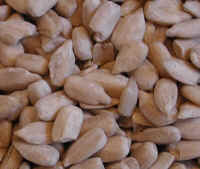
(Sunflower Seeds) The sunflower seeds in this photo are raw and machine hulled.
We use them in baking and sprinkle them on our salads. We purchase our raw
sunflower seeds from health food store, specialty supermarkets, and from
cooperatives. Sunflower seeds are nearly 50% fat, and can go rancid if stored at
room temperature, so we always store them in our freezer. To enlarge the
photo and see the nutritional chart, click on the photo or link.
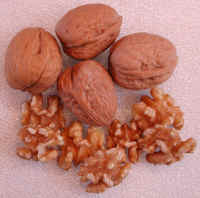
(Walnuts)
The commercially available walnuts are the English walnut (pictured). The
English walnut has been grown commercially in Europe since Roman times.
Walnuts are probably the most popular of the hard shell nuts. See
nutritional chart by clicking on the photo or link.
Return to: Ingredients Description and Photos
 The
above recipe is in keeping with God's creation intent (Genesis 1:29-31):
'Then God said, "I give you every seed-bearing plant on the face of the whole earth and every
tree that has fruit with seed in it. They will be yours for food. And to all the beasts of the
earth and all the birds of the air and all the creatures that move on the ground-- everything that
has the breath of life in it-- I give every green plant for food." And it was so. God saw all
that he had made, and it was very good.' (NIV) Let no animal suffer or die that we may live!
The
above recipe is in keeping with God's creation intent (Genesis 1:29-31):
'Then God said, "I give you every seed-bearing plant on the face of the whole earth and every
tree that has fruit with seed in it. They will be yours for food. And to all the beasts of the
earth and all the birds of the air and all the creatures that move on the ground-- everything that
has the breath of life in it-- I give every green plant for food." And it was so. God saw all
that he had made, and it was very good.' (NIV) Let no animal suffer or die that we may live!
Recipe Section
Main Web Site
- Home Page
- What's New
- Contact Us
- Action Alerts
- Animal Exploitation
- Animal Issues
- Animal Rights Activism
- Archives
- Art & Photography
- Articles Directory
- Bible
- Bible Commentary Blog
- Books
- Campaigns
- Church & Religion
- Discussions
- Donate
- Events / Podcasts / Media
- Health
- Hosted Sites
- Humor
- Kids' Korner
- Letters
- Links
- Nature Studies
- Newsletter
- Poetry & Stories
- Prayers
- Quotations
- Recipes with Photos
- Recipes Without Photos
- Sermons
- Stop Cruelty in Churches
- Video Library
- The Mary T. and Frank L. Hoffman Family Foundation
Follow us on:


A web site sponsored by The Mary T. and Frank L. Hoffman Family Foundation and all-creatures.org
Copyright © 1998-2026 The Mary T. and Frank L. Hoffman Family Foundation. All rights reserved. May be copied only for personal use or by not-for-profit organizations to promote compassionate and responsible living. All copied and reprinted material must contain proper credits and web site link www.all-creatures.org.
Fair Use Notice: This document, and others on our web site, may contain copyrighted material whose use has not been specifically authorized by the copyright owners. We believe that this not-for-profit, educational use on the Web constitutes a fair use of the copyrighted material (as provided for in section 107 of the US Copyright Law). If you wish to use this copyrighted material for purposes of your own that go beyond fair use, you must obtain permission from the copyright owner.
Thank you for visiting all-creatures.org.
Since 