 Beans
and Legumes - Ingredients Descriptions and Photos
Beans
and Legumes - Ingredients Descriptions and Photos
From All-Creatures.org Vegan - Vegetarian Recipe Book: How Mary and Frank and Friends Eat
"We are dedicated to cruelty-free living through a vegetarian - vegan lifestyle. Let no animal suffer or die that we may live!"
Ingredients Descriptions and Photos
Beans and Legumes

(Beans, Black)
Black beans, or black turtle beans, as they are also known, may
have been so named because of their shiny black appearance. They are one
of the smaller sized bean. Black beans are a variety of the common bean
which has a 7,000 year history in Central America, where they originated. Black
beans are very nutritious and hold their shape well while cooking. We put cooked
black beans on our salads, and use them in soups and in a number of main dishes,
especially Latin American and Caribbean dishes. See our nutritional charts
and recipes by clicking on the photo or link.

(Beans, Black, Canned)
Canned black beans are a quick and easy way to enjoy
this bean on salads and in "quick" recipes. Do not buy canned black beans
that have sugar or corn syrup added. The major drawback to using canned
black beans is the added salt, but pouring off the liquid before using them in a
recipe will reduce some of the salt. To see the nutritional chart, click
on the photo or link.

(Beans, Cannellini, canned)
Cannellini are white kidney beans. We use
these canned cannellini beans because of their convenience. Their only
drawback is the salt content, but these beans can be used in combinations with
other unsalted ingredients to add the salt taste. We use these white
kidney beans as a base for dips, in "quickie" soups, and in a mixed bean salad.
See the nutritional chart by clicking on the photo or link.

(Cranberry Beans) The borlotti bean is a
variety of the cranberry bean, a common bean (Phaseolus vulgaris) first bred
in Colombia as the cargamanto. It is also known as Roman bean, and romano
bean. The literature also says that the borlotti bean is a variety of the
cranberry bean bred in Italy to have a thicker skin. It is used in Italian,
Portuguese (Catarino bean), Turkish, and Greek cuisine. The cranberry bean
looks similar to the pinto bean, but cranberry beans are larger and have big
maroon specks on a creamy white background, more like Great Northern beans.
After cooking, however, the specks vanish and the beans take on a more even,
darker color. These cranberry beans don't have the creamy white background,
but instead have darker color of the cooked beans, and we have not seen
anything to explain the difference. To enlarge the photo and see the
nutritional information, click on the photo or link.

(Beans, Great Northern)
Great northern beans are one of the fastest cooking
beans. They usually begin to fall apart after about one hour of cooking
time, without pre-soaking. We usually cook them for about 2 hours.
To enlarge the photo and see the nutritional information, click on the photo or link.

(Beans, Great Northern, Canned)
Even though great northern beans are one of
the fastest cooking beans, the canned beans are a convenient way to enjoy these beans
for a quick meal. They can be added to salads, vegetable soups, and for
making cream sauces and dips. To enlarge the photo and see the
nutritional information, click on the photo or link.

(Beans, Green)
The most commonly eaten fresh beans are the green beans, which
are also called snap beans or string beans. The outer green covering is an
edible bean pod. We enjoy them raw in salads or with dips, or cooked plain
or in other dishes. Select beans that are young (without large bulges in
the pod from maturing beans), firm, and bright in color and without blemishes.
The outer texture of the bean should feel velvety. See the nutritional
charts for raw and cooked green beans by clicking on the photo or link.

(Beans, Kidney)
Kidney beans are so-called, because they are shaped like a
kidney, and they usually hold their shape when cooked. One of the other
nice features of kidney beans is that they absorb the flavor of the seasonings
with which they are being cooked. Kidney beans and other beans such as
pinto beans, navy beans and black beans are known scientifically as Phaseolus
vulgaris. They are referred to as “common beans” probably owing to the fact that
they all derived from a common bean ancestor that originated in Peru. They
are high in protein (22.5%), and very nutritious. To enlarge the photo and
see the nutritional chart, click on the photo or link.

(Beans, Kidney, canned)
Red kidney beans are high in fiber. We use
canned kidney beans for their convenience. Their only drawback is their
salt content, but when mixed with other unsalted ingredients, the beans add the
salt taste. The canned kidney beans are great for "quickie" soups and for
mixed bean salads. See the nutritional chart by clicking on the photo or link.

(Beans, Kidney, Dark Red)
We could not find a lot of specific information about dark red kidney kidney
beans; however, on eHow, we did find this comment: "Dark red kidney beans and
light red kidney beans, while slightly different in color, are extremely similar
in flavor, texture and nutritional value. While the two beans are actually
different species, they can be used interchangeably." Dark red kidney been have
a slightly thicker skin than the lighter red species, but we could find nothing
about the specific species name, and references still list them as native to
Central and South America. Dark red kidney beans, like other kidney beans have a
whitish interior. We use these cooked dark red kidney beans on our salads,
in chili, and in other recipes calling for kidney beans.

(Beans, Lima, Baby)
Baby lima beans are a smaller, thin-skinned, milder
flavored variety; they are not the same as the immature large lima beans.
Baby lima beans are also less starchy than the larger "Fordhook" or "Butter"
variety. Lima beans are believed to have originated in Guatemala and
Southern Mexico about 5,000 years ago. Baby limas are slightly over 20%
protein and are very nutritious. To enlarge the photo and see the
nutritional chart, click on the photo or link.

(Beans, Mayocoba) Mayocoba beans develop a
creamy texture when cooked. For us, this makes them ideal for soups and
other recipes. They also absorb the flavor of the recipe. Mayocoba beans are
also labeled as Peruano, Canary, and even Mexican Yellow Beans. We are not
sure why one name is prefered over another, so we have listed them
separately. We enjoy the creamy texture in soups, which we like making in
our pressure cooker and letting it soak warm for another hour or so, which
really developes the creaminess of the beans.
We could not find any specific detailed information for these beans. The
label does indicate that they are very low in fat, and that a 1/4 cup (35g.)
of dry beans has 23 g. carbohydrate, of which 9 g. is fiber, and 7 g.
protein.

(Beans, Mung)
Mung beans are among the smallest of beans. They are quite
common in Asia, but are not usually sold in supermarkets in the United States.
We purchase our mung beans from our coop, a health food store, or from a
specialty food store. Sprouted mung beans are a common ingredient in many
Chinese recipes. Mung beans are also used to make cellophane noodles.
Whole mung beans can also be used in soup and other recipes.

(Beans, Navy)
Navy beans got their name because they used to be a staple on U.
S. Naval ships. They are a mild flavored bean which is excellent for soups
and baking. Navy beans and other beans, such as pinto beans and black
beans, are all known scientifically as Phaseolus vulgaris. They are referred to
as “common beans” probably because they all derived from a common bean ancestor
that originated in Peru. Navy beans are high in protein (22.33%) and
minerals. To enlarge the photo and see nutritional chart, click on the
photo or link.

(Beans, Peruano)
Peruvian beans, also called canary beans, are rather distinctive. Due to
their density, they take on a large stature when cooked, as a result, they
take longer to cook. The peruano beans have an unusual yellow-tan color that
also marks the Peruvian bean. Wise Geek says: Peruvian bean lovers prize
these beans for their creaminess and softness. In this manner, the beans
contrast other bean varieties that may have more of a liquid, soupy, and
hard appearance. This particular texture often results from slow simmering
of the beans. Bean eaters may describe the taste of these beans as very rich
and somewhat buttery. And, we concur. They are great in soups and on salads.
We also found it interesting that peruano beans actually orginally came from
Mexico, where they are very popular. To enlarge the photo and see the
nutritional information, click on the photo or link.

(Beans, Pinto)
Pinto beans are so named because of their characteristic spots.
Pinto beans are related to kidney beans, but, in our opinion, they have a
stronger flavor. They are a native of Mexico and are used in many of their
recipes. Pinto beans can also be pureed and used in dips, as a soup base,
or to thicken soups and sauces. To enlarge the photo and see the
nutritional information, click on the photo or link.

(Beans, Pinto, Canned)
Most of the characteristic spots of the dry pinto bean
disappear when cooked. We prefer to cook the dry beans, but the canned
beans are great (except for the added salt) for preparing a quick meal.
Canned pinto beans can be used in dips, for a tortilla filling, or in soups.
To enlarge the photo and see the nutritional information, click on the photo or link.

(Beans, Small Red)
Small red beans are similar to red kidney beans, except
that they are smaller in size, and, in our opinion, their flavor is slightly
different. Small red beans are also called Mexican Red Beans. They hold
their shape and firmness when cooked. Small red beans can be used in
soups, salads, chili and Creole dishes.

(Black-eyed Peas or Cowpeas)
Black-eyed peas (beans) are wonderful in soups, which
is the most frequent way that we prepare them. Every bean variety has a
slightly different flavor and it is good to try different ones in your recipes.
See the nutritional chart for
raw and cooked black-eyed peas by
clicking on the photo or link.

(Black-eyed Peas or Cowpeas, Canned)
Canned black-eyed peas are a convenient and
quick way to enjoy these delicious beans; the only drawback being that most
canned black-eyed peas are prepared with salt. For this reason, we
recommend draining off the liquid before adding the black-eyed peas to your
recipe. Canned black-eyed peas can be used in salads, dips, tortilla
filling, and other recipes.

(Carob Powder)
Carob powder is produced by grinding the roasted beans from
the pods of a Mediterranean evergreen leguminous tree. For many people,
including us, carob has taken the place of cocoa and chocolate. And,
unlike cocoa and chocolate, carob has no caffeine and almost no fat. And
since carob is sweet, it requires much less sweetener than chocolate and cocoa.
See the nutritional chart by clicking on the photo or link.

(Chick Peas or Garbanzos)
Dried chick peas (garbanzos) are cooked and eaten
on salads, or in soups or other dishes. The dried beans (peas) are also
ground into a flour for making falafel or other recipes. Chick peas are
higher in fat and protein than other commonly eaten beans. See the
nutritional chart for
raw and cooked chick peas by clicking
on the photo or links.

(Chick Peas or Garbanzos, Canned)
Canned chick peas (garbanzos) are a quick
way to enjoy this bean in salads and other recipes. The drawback to the
canned variety of chick peas is that they are usually prepared with salt.
We suggest that you drain off the liquid before using them. Mostly, we use
canned chick peas on our salads, as a last minute treat. Chick peas are
higher in fat and protein than other commonly eaten beans. See the
nutritional chart by clicking on the photo or link.

(Lentils)
Lentils are legumes (beans) that have been cultivated for thousands of years.
The actual size of a lentil is about 1/4 inch. They are mentioned in the
Bible in 2 Samuel 17:28, 23:11 and in Ezekiel 4:9 where they are one of the
ingredients of Ezekiel's bread. Nutritional information: a 1/4 cup (dry)
serving of lentils (32 grams) has no fat, 19 grams of complex carbohydrate - 10
grams of which is digestible (40 calories) and 9 grams in the form of dietary
fiber - and 8 grams of protein (32 calories). A serving of lentils also
provides 15% of our daily requirement of iron.

(Lentils, French)
French lentils are a small dark speckled lentil, which are
sometimes referred to as "green". They are a firmer lentil that takes a
little longer to cook, but they have an excellent flavor. French lentils
originated in Southeast Asia along the Indus River, where they remain quite
popular. Their French name "Puy" comes from their growth in the Puy region of
France. We have not found French lentils in supermarkets in the United States,
but they are readily available from coops, health food stores, and many
specialty food stores. They are an excellent ingredient for soups, salads,
and many other recipes, including curries. The actual size of the French
green lentils can be seen in the photo of the cup to the left. We could
not find nutritional chart information for these lentils, but like other
lentils, the French green are low in fat and high in protein and fiber.

(Lentils, Red)
Red lentils are the fastest cooking lentil that we have prepared.
The skins begin to come off after about five minutes of cooking and the lentils
begin to come apart after about ten minutes. During the cooking process,
the red lentils change from their red color to a yellow-gold color. They
are great for making soups and chowders. The only places we have found
that sell red lentils are health food stores and food coops. We could not
find specific nutritional information for "red" lentils, but did find
information on "pink" lentils, which we suspect may be the same lentil with a
different name.
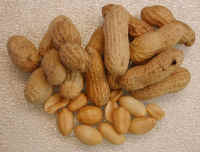
(Peanuts)
Peanuts are not really a nut, but an underground growing bean or pea, which led
to their being called "Goober's peas". Dry roasted peanuts are good
tasting, a fun food (especially when in the shell) and not a junk food; but they
are very high in calories because of their high oil content. The
nutritional chart, which can be seen by clicking on the photo or link, is for
the shelled nuts.

(Peas, Green Split)
Green split peas are commonly sold in 1-pound bags in
most supermarkets. Organic green split peas can be found in most health
food stores. We have found that green split peas are usually the least
expensive dried bean in the markets. When cooked, they easily break down
to make a thick creamy soup or chowder, and unlike other legumes, split peas
require no pre-soaking, and will soften in about two hours. See the
nutritional chart for raw and cooked split peas by clicking on the photo or link.

(Peas, Yellow Split)
Yellow split peas are not commonly found in the United
States, but they are quite popular in Northern Europe and other parts of the
world. Some larger supermarkets carry yellow split peas in the ethnic food
section, where they are usually sold in 1-pound plastic bags. They are
almost always found in health food stores, where they are sold unpackaged in
bulk bins. Both green and yellow split peas, have an advantage over dried
beans: they are as nutritious as beans, but they do not need to be soaked before
they're cooked, that is, unless they have been stored for a long time. For
this reason, it is best to buy yellow split peas from a store that has a high
turnover of their stock. We could not find specific nutritional information for
yellow split peas.

(Soup Mix)
This soup mix is a blending of approximately two dozen different
dried beans and grains (not all are visible in the photos). We purchase
this mix from our food co-op. The photo to the left shows the actual size
of the soup mix beans and grains. This soup mix adds interest and variety
to any bean soup. Try our spicy mixed bean
soup or a recipe of your own.

(Soybeans)
Soybeans are not generally sold in supermarkets, but they are available at
hearth food stores and from coops. Some of the most common uses of
soybeans are in making textured vegetable protein (TVP), soy milk, and tofu.
Soybeans have been grown in China for over 3,000 years, but are now grown in
many parts of the world. Soybeans must be cooked in order for the protein
to be digested. To enlarge the photo and see our nutritional charts for raw and
cooked soybeans, click on the photo or link.

(Tofu, block)
This is a one pound block of firm tofu, a bean curd made from
soy beans. Tofu is a very versatile product. It can be broiled or
roasted. It can be used in salads, soups, stir fries, dips, and in making
cream sauces. Tofu has very little flavor of its own, but readily picks up
the flavor of the other ingredients. See nutritional information by
clicking on the photo or link.
Return to: Ingredients Description and Photos
 The
above recipe is in keeping with God's creation intent (Genesis 1:29-31):
'Then God said, "I give you every seed-bearing plant on the face of the whole earth and every
tree that has fruit with seed in it. They will be yours for food. And to all the beasts of the
earth and all the birds of the air and all the creatures that move on the ground-- everything that
has the breath of life in it-- I give every green plant for food." And it was so. God saw all
that he had made, and it was very good.' (NIV) Let no animal suffer or die that we may live!
The
above recipe is in keeping with God's creation intent (Genesis 1:29-31):
'Then God said, "I give you every seed-bearing plant on the face of the whole earth and every
tree that has fruit with seed in it. They will be yours for food. And to all the beasts of the
earth and all the birds of the air and all the creatures that move on the ground-- everything that
has the breath of life in it-- I give every green plant for food." And it was so. God saw all
that he had made, and it was very good.' (NIV) Let no animal suffer or die that we may live!
Recipe Section
Main Web Site
- Home Page
- What's New
- Contact Us
- Action Alerts
- Animal Exploitation
- Animal Issues
- Animal Rights Activism
- Archives
- Art & Photography
- Articles Directory
- Bible
- Bible Commentary Blog
- Books
- Campaigns
- Church & Religion
- Discussions
- Donate
- Events / Podcasts / Media
- Health
- Hosted Sites
- Humor
- Kids' Korner
- Letters
- Links
- Nature Studies
- Newsletter
- Poetry & Stories
- Prayers
- Quotations
- Recipes with Photos
- Recipes Without Photos
- Sermons
- Stop Cruelty in Churches
- Video Library
- The Mary T. and Frank L. Hoffman Family Foundation
Follow us on:


A web site sponsored by The Mary T. and Frank L. Hoffman Family Foundation and all-creatures.org
Copyright © 1998-2026 The Mary T. and Frank L. Hoffman Family Foundation. All rights reserved. May be copied only for personal use or by not-for-profit organizations to promote compassionate and responsible living. All copied and reprinted material must contain proper credits and web site link www.all-creatures.org.
Fair Use Notice: This document, and others on our web site, may contain copyrighted material whose use has not been specifically authorized by the copyright owners. We believe that this not-for-profit, educational use on the Web constitutes a fair use of the copyrighted material (as provided for in section 107 of the US Copyright Law). If you wish to use this copyrighted material for purposes of your own that go beyond fair use, you must obtain permission from the copyright owner.
Thank you for visiting all-creatures.org.
Since 