 Grains
and Bread Making Ingredients - Ingredients Descriptions and Photos
Grains
and Bread Making Ingredients - Ingredients Descriptions and Photos
From All-Creatures.org Vegan - Vegetarian Recipe Book: How Mary and Frank and Friends Eat
"We are dedicated to cruelty-free living through a vegetarian - vegan lifestyle. Let no animal suffer or die that we may live!"
Ingredients Descriptions and Photos
Grains and Bread Making Ingredients
Table of Contents

(Amaranth)
Amaranth is a very small grain which is a native of South America. The
actual size of the amaranth grain can be seen in the photo to the left.
Amaranth is high in protein, calcium and iron. From our experience,
amaranth is only available in health food stores and from food cooperatives.
Amaranth can be used in its whole grain form like rice, or in other dishes, or
it can be ground into flour and used in many baking recipes, as multi-grain
bread. See the nutritional chart by clicking on the photo or link.

(Baking Powder)
Baking powder is used in baking non-yeast breads, cakes, and
muffins, and causes the dough to rise by producing tiny bubbles of carbon
dioxide that get trapped in the dough, just as yeast does. It is a
leavening agent composed of different chemical formulations of an acid salt
(various), and an alkaline salt, usually baking soda (sodium bicarbonate).
There are two types of baking powder: single acting, which contain such
chemicals as calcium hydrogen tartrate (cream of tarter), calcium phosphate, or
calcium citrate, which begins to work at room temperature as soon as the wet
ingredients are added to the dry ingredients; and double acting, which also
reacts at higher temperatures during the baking process, and usually contain an
aluminum salt, such as calcium aluminum phosphate, which may be harmful to
health because of its aluminum content. To keep baking powder fresh and to
prevent the moisture in the air from starting the chemical reaction, it is best
to store baking powder in a tightly sealed container in the refrigerator or
freezer. If you wish to avoid the aluminum, and use only the single acting
baking powder, a less expensive substitute can be used: for every teaspoon of
baking powder called for in the the recipe, add 1/2 teaspoon of baking soda to
the dry ingredients, and 1-1/2 teaspoons of lemon juice or vinegar to the wet
ingredients. Happy baking!

(Barley)
Most people are familiar with pearl barley, but whole grain barley has a much
fuller flavor, as well as being more nutritious. Barley was also an
important grain in Biblical times, being the grain that Ruth gleaned in Boaz's
field some 3,000 years ago. We purchase our whole grain barley from the
co-op or from a health food store. We use whole grain barley as one of the
ingredients in bread and in other recipes containing barley. See the
nutritional chart by clicking on the photo or link.

(Barley, Pearl)
Pearl barley is a barley that is polished to give it
"market appeal". Barley is an ancient grain, being mentioned in early
historic writings. Barley is mentioned in the Bible as one of the crops of
Egypt (Exodus 9:31), and was an ingredient in the bread that God told Ezekiel to
bake (Ezekiel 4:9). 33 grams of barley (1/4 cup, dry) contains no fat, 24
grams of complex carbohydrate (96 calories), 3 grams of protein (12 calories),
and 5 grams of dietary fiber.
Corn Grits (see Polents)

(Corn on the Cob - Bicolor)
Most people probably think of corn on the cob as
a vegetable, but it is really a grain. There are several common varieties
of corn on the cob: yellow, white, and mixed white and yellow, which is pictured
here. In our experience, we have seen only the yellow variety sold frozen
either on the cob or cut. We have found a variety of flavors in corn on
the cob depending on where it is grown and how long it has been since it was
harvested. The longer it has been since the corn was harvested, the more
bland the flavor, and the more "gummy" the texture. We have found it best
to buy only fresh corn on the cob that has a nice green husk.
We could not find any nutritional information for bicolor yellow and white corn
on the cob, but estimate that it should be somewhere in the middle of the
nutritional information we have for white corn on
the cob and yellow corn on the cob.
To enlarge the photo, click on the photo or link.

(Corn on the Cob - White)
Most people probably think of corn on the cob as a
vegetable, but it is really a grain. There are several common varieties of
corn on the cob: yellow, mixed white and yellow, and white, which is pictured
here. In our experience, we have seen only the yellow variety sold frozen
either on the cob or cut. We have found a variety of flavors in corn on
the cob depending on where it is grown and how long it has been since it was
harvested. The longer it has been since the corn was harvested, the more
bland the flavor, and the more "gummy" the texture. We have found it best
to buy only fresh corn on the cob that has a nice green husk. See the
enlarged photo and the nutritional chart for raw white corn on the cob by
clicking on the photo or link. We could not find any nutritional
information for cooked white corn on the cob, but it is probably very similar to
the differences between the raw and cooked information for
yellow corn on the cob.
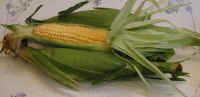
(Corn on the Cob - Yellow) Most people probably think of corn on the cob as
a vegetable, but it is really a grain. There are several common varieties
of corn on the cob: white, mixed white and yellow, and the yellow, pictured
here. In our experience, we have seen only the yellow variety sold frozen
either on the cob or cut. We have found a variety of flavors in corn on
the cob depending on where it is grown and how long it has been since it was
harvested. The longer it has been since the corn was harvested, the more
bland the flavor, and the more "gummy" the texture. We have found it best
to buy only fresh corn on the cob that has a nice green husk. See the
nutritional chart by clicking on the photo or link.

(Corn Masa Flour) Corn masa flour is made from dehydrated, finely ground
whole grain corn and lime. It's primarily used for making tortillas and other
Mexican, and Central and South American recipes. We also use the corn masa
flour as a coating and dusting flour, as a thickening agent, and in baking.
We could not find the nutritional information for the whole grain masa flour
with lime. Since we use only whole grains, we could not be completely sure
of the actual nutritional content of this flour, which we believe is somewhere
in between the nutritional information for whole-grain and masa flours, which
can be seen by clicking on the photo or link.

(Corn, Popping)
Popcorn is usually considered a snack food, but when
air-popped, it is quite a healthful food, unlike oil-popped and candy coated
popcorn, and potato chips. We usually air-pop our popcorn in our microwave
oven in a special container we purchased specifically for this purpose, or in a
hot air popping machine. While the so-called gourmet popcorn may produce
slightly larger volumes of popped corn, we have found that the price difference
is unjustified, and usually purchase store, or either organic or non-organic
off-brand popping corn seed. Unfortunately, we have found some very poor
quality organic popcorn, and, as a result, usually purchase a store brand at a
local supermarket at about $0.50/lb. For popcorn recipes, go to our
Snacks
sub-section. To enlarge the photo and see the nutritional chart, click on
the photo or link.

(Carob Powder) Carob powder is produced by grinding the roasted beans from
the pods of a Mediterranean evergreen leguminous tree. For many people,
including us, carob has taken the place of cocoa and chocolate. And,
unlike cocoa and chocolate, carob has no caffeine and almost no fat. And
since carob is sweet, it requires much less sweetener than chocolate and cocoa.
See the nutritional chart by clicking on the photo or link.

(Kamut) Kamut brand wheat is the registered trade name of Kamut International, Ltd., who
cultivated a viable grain that was supposedly found in a jar in a pyramid in
Egypt and planted it in the United States. This could be the Egyptian
wheat mentioned in the Bible (Exodus 9:32). The nutritional values of
kamut are compared with conventional wheat (Kamut).

(Lecithin, Soya) We primarily us soya lecithin as an emulsifier in our bread
recipes. It is also used as an ingredient of dough enhancers: for every
cup of flour, we use 1 tsp. of soya lecithin, 1/8 tsp. vitamin C (ascorbic
acid), and 1/8 tsp. of ground ginger. Lecithin is a mixture of fats:
glycolipids, triglycerides, and phospholipids. It also produced naturally
in our livers, when the person is eating a healthful diet. Every cell in the
body requires lecithin for building the cell walls, for without it, the walls
would become hardened. Soya lecithin is extracted from soy beans using
hexane and then refined. To enlarge the photo and see the nutritional
chart, click on the photo or link.

(Lentils)
Lentils are legumes (beans) that have been cultivated for thousands of years.
The actual size of a lentil is about 1/4 inch. They are mentioned in the
Bible in 2 Samuel 17:28, 23:11 and in Ezekiel 4:9 where they are one of the
ingredients of Ezekiel's bread. Nutritional information: a 1/4 cup (dry)
serving of lentils (32 grams) has no fat, 19 grams of complex carbohydrate - 10
grams of which is digestible (40 calories) and 9 grams in the form of dietary
fiber - and 8 grams of protein (32 calories). A serving of lentils also
provides 15% of our daily requirement of iron.

(Millet, Yellow)
Yellow Millet is an ancient grain that was grown in Biblical
times. It is mentioned as one of the ingredients in Ezekiel's bread
(Ezekiel 4:9). The actual size of a grain of millet is approximately 1/16
inch across. A 1/4 cup (dry) serving (46 grams) of millet has no fat, 26
grams of complex carbohydrate (104 calories) of which 14 grams are dietary
fiber, and 13 grams of protein (52 calories). A serving of millet also
provides the following daily requirements: vitamin C - 4%, calcium - 2%, and iron - 25%.

(Oats, Rolled) Rolled oats are a processed form of the whole grain produced
by steaming and passing between steel rollers. This helps it cook faster.
A 1/2 cup (dry) serving of rolled oats (39 grams) contains 3 grams of fat (27
calories) of which 0.5 grams is saturated fat, 26 grams of complex carbohydrate
of which 22 grams are edible (88 calories) and 4 grams are dietary fiber, and 5
grams of protein (20 calories). One serving of oats also supplies 10% of
our daily requirement of iron.

(Oats, Irish (Steel-Cut)) Steel-cut oats are also called Irish oats,
particularly when made into oatmeal. They are a cut, but otherwise
unprocessed form of whole grain oats, which have a more robust flavor than
rolled oats when making oatmeal, though they do take more time to cook.
Steel-cut oats differ from rolled oats which are flake oats that have been
steamed, rolled, re-steamed and toasted. Due to all of this additional
processing they have lost some of their natural taste, goodness and texture,
which the steel-cut oats retain. To enlarge the photo and see the
nutritional chart, click on the photo or link.

(Polenta (Corn Grits)) Polenta or corn grits
are a form of cracked corn that are cooked in 3 times the amount of water.
The resulting cooked polenta is a traditional staple of Northern Italy and
the Southern American States. It is eaten as a cereal, a side dish with or
without a sauce, and in other recipes. Cooking time is very similar to that
of rice.

(Quinoa)
Quinoa (pronounced keen-wah) is a native "grain" or seed of a high Andes
pig weed that has been widely used for food in Peru. It is high in
protein, calcium, and iron. The actual size of quinoa can be seen in the
photo to the left. From our experience quinoa is only available in health
food stores or from food cooperatives. Quinoa can be used whole like rice,
or in soups, or ground and used in baking, as in multi-grain bread. See
the nutritional chart by clicking on the photo or link.

(Rice, Black Sticky) Black sticky rice, or kao niow dahm (kao is rice; niow,
sticky; dahm, black), as it is known in Thailand, is also called black sweet
rice, black glutinous rice, and Indonesian rice. The wonderful flavor of
black sticky rice makes it a favorite in Southeast Asia, where it is primarily
used for breakfast, puddings and other desserts, but we have found that it also
makes a great bed for cooked Asian fruit and veggie recipes. We could
not find any specific nutritional information for black sticky rice.

(Rice, Brown) We buy and eat only whole grain brown rice, like this or other
varieties. Brown rice retains the bran and germ which contain many of the
nutrients and the fiber. Brown rice also has more flavor, which some
people describe as "nutty". This is really the natural flavor of rice,
which has been removed from "white rice" along with many of the nutrients.
See nutritional charts by clicking on the photo or link.

(Rice, Brown Basmati) Brown basmati rice is a stronger flavored whole grain
rice that is a native of India. Recently, we have seen brown basmati rice
that has been grown in the United States. It is a great addition to curry
flavored dishes. We purchase our brown basmati rice from health food
stores or from a food co-op. As its popularity grows, we expect that it
will become available in most supermarkets. The photo to the left shows
the actual size of the rice. Brown basmati rice is more nutritious than
the polished white variety; and we believe that it is always better to eat whole
grains, rather than processed grains.

(Rice, Jasmine) a long-grain variety of fragrant rice (also known as
aromatic rice). Its fragrance, reminiscent of pandan and popcorn, results
from the rice plant's natural production of aromatic compounds. The name
"jasmine" refers to the color of the rice, which is as white as the jasmine
flower. It is moist and soft in texture when cooked, with a slightly sweet
flavor. The grains cling and are somewhat sticky when cooked. We could not
find any detailed nutritional information. The only nutritional information
on the rice bag was carbohydrates.

(Rice, Brown Jasmine) Brown jasmine rice
is an aromatic sticky rice, but we have found that it is not as aromatic as
the white jasmine rice; however, the brown jasmine rice is much more
healthful because it still contains the bran. Another name for jasmine rice
is Mekong flower rice. Brown jasmine rice was originally only grown in
Thailand, but it is now grown in other parts of the world. To enlarge the
photo and see the nutritional information, click on the photo or link.

(Rice, Wild) Wild rice is a native American grain that is as old as recorded
history. The harvesting of wild rice traditionally was done along streams
and lakes where it was growing naturally. In more recent years, wild rice
has been "naturally cultivated" to increase the yield. However, wild rice
is still several times more expensive than any of the other types of rice we
have encountered. At more than $3.00 (US) per pound, it remains a gourmet
delicacy. Wild rice takes a little longer to cook than brown or basmati,
but if cooked together with other types of rice and allowed to remain in the pot
for another 15 minutes after cooking, it will be tender. To enlarge the
photo and see the nutritional, click on the photo or link.

(Rye)
Rye is a relatively modern grain of unknown origin; there is no mention of it in
ancient writings. The food value of rye consists of 1.5% fat, 73.9%
complex carbohydrate, and 12.2% Protein. The balance of the rye grain
consists of 1.9% ash and 10.5% water.

(Rye Flakes) Rye flakes are made from whole grain rye
berries or groats that have usually been cut and steamed to soften them, and
then rolled between steel rollers to form the flakes. This is very similar to
the way that rolled oats are make. Rye, however has a sweeter taste than oats. Rye
flakes can be cooked in water or apple juice to make a breakfast cereal, or
added or substituted for oats to make cookies or bread. They can be purchased
from most health food stores, coops, and some supermarkets. We could not find
the complete nutritional information for rye flakes that we have for most of the
other ingredients we have posted, so we posted a partial list from one of the
producers of rye flakes.

(Sesame Seeds) Sesame seeds come from the seed pods of Sesamum indicum. They
were used by the Assyrians as far back as 1,600 - 3,000 B.C.E., depending on the
reference source. We use sesame seeds as an outer coating for some of our bread
and roll recipes, and as an ingredient in dips, dressings, and other recipes.
To enlarge the photo and see the nutritional chart, click on the photo or link.

(Spelt)
Spelt is another of the ancient grains mentioned in the Bible. It is
recorded in Exodus 9:32 as one of the grains grown in Egypt. Isaiah wrote
about spelt in his book (28:25), and spelt was one of the ingredients in
Ezekiel's bread (Ezekiel 4:9). A 2 oz. (56.7 grams) dry serving of spelt
contains 216 calories, consisting of 1.67 grams of fat (15 calories), 42.25
grams of complex carbohydrate (169 calories), and 8.1 grams of protein (32 calories).

(Wheat, Hard Red) Even though wheat is mentioned in ancient writings, it is
not the same as the commercial wheat we have today. Our present day wheat
is a variety of hybrid wheat grains which were developed from about 1920.
From what we have learned, this hybrid wheat is more allergenic than the
traditional "wheat". A 100 gram (dry) portion of wheat contains 1.9 grams
of fat (17 calories), 72.7 grams of complex carbohydrate (291 calories), and
12.3 grams of protein (49 calories). (See Kamut
for a detailed comparison of nutritional values between our modern day wheat and Kamut.)

(Wheat, Hard White) We like
the hard white wheat berries for grinding into flour, because it seems to make a
lighter texture and sweeter tasting bread. Hard white wheat is the newest class
of wheat marketed in the U.S., but it is not new to the rest of the world. Wheat
in this class has a hard endosperm and white bran. Except for the absence in
color in the outer seed coat and being typically more prone to weathering, hard
white wheat is identical to hard red wheat. The white bran color does not alter
the starch characteristics or protein functionality of the kernel. We could not
find any nutritional information specifically for hard white wheat berries or
flour, so we inserted the nutritional chart for whole wheat flour.

(Vitamin C (Ascorbic Acid)) At first thought, it might seem strange to include
vitamin C powder as a recipe ingredient; however, vitamin C has been found to be
a dough enhancer when used in conjunction with Ginger and Soya Lecithin.
The ascorbic acid strengthens the gluten bonds so that the rising dough is
better able to retain the gas bubbles. The ginger accelerates the yeast,
and the soya lecithin acts as an emulsifier. Typically, for every cup of flour,
add 1 tsp. soya lecithin, 1/8 tsp. ground ginger, and 1/8 tsp. ascorbic acid
powder. We purchased our vitamin C powder (ascorbic acid) in the health food store.

 (Yeast)
Yeast are single-celled plants. They are fungus that ferment starches and
sugars. One of the by-products of this fermentation process is carbon
dioxide gas which forms little bubbles in bread dough and causes it to rise.
These fungus plants are killed during baking. We purchase our yeast in
bulk (1 or 2 pound packages) and store in tightly sealed glass jars in our
refrigerator . We have found two forms of commercial yeast: the one
pictured above left is an enlargement of the "bead" or granular form of dried
yeast clusters, and the other, (Yeast 2), pictured
right in an enlargement, is the extruded form of commercial yeast. Note
that the "cylinders" of yeast have become polarized, and that the static
electricity and magnetic field causes them to stick together end to end.
As far as performance in baking, there is no difference in various forms of yeast.
(Yeast)
Yeast are single-celled plants. They are fungus that ferment starches and
sugars. One of the by-products of this fermentation process is carbon
dioxide gas which forms little bubbles in bread dough and causes it to rise.
These fungus plants are killed during baking. We purchase our yeast in
bulk (1 or 2 pound packages) and store in tightly sealed glass jars in our
refrigerator . We have found two forms of commercial yeast: the one
pictured above left is an enlargement of the "bead" or granular form of dried
yeast clusters, and the other, (Yeast 2), pictured
right in an enlargement, is the extruded form of commercial yeast. Note
that the "cylinders" of yeast have become polarized, and that the static
electricity and magnetic field causes them to stick together end to end.
As far as performance in baking, there is no difference in various forms of yeast.
Return to: Ingredients Description and Photos
 The
above recipe is in keeping with God's creation intent (Genesis 1:29-31):
'Then God said, "I give you every seed-bearing plant on the face of the whole earth and every
tree that has fruit with seed in it. They will be yours for food. And to all the beasts of the
earth and all the birds of the air and all the creatures that move on the ground-- everything that
has the breath of life in it-- I give every green plant for food." And it was so. God saw all
that he had made, and it was very good.' (NIV) Let no animal suffer or die that we may live!
The
above recipe is in keeping with God's creation intent (Genesis 1:29-31):
'Then God said, "I give you every seed-bearing plant on the face of the whole earth and every
tree that has fruit with seed in it. They will be yours for food. And to all the beasts of the
earth and all the birds of the air and all the creatures that move on the ground-- everything that
has the breath of life in it-- I give every green plant for food." And it was so. God saw all
that he had made, and it was very good.' (NIV) Let no animal suffer or die that we may live!
Recipe Section
Main Web Site
- Home Page
- What's New
- Contact Us
- Action Alerts
- Animal Exploitation
- Animal Issues
- Animal Rights Activism
- Archives
- Art & Photography
- Articles Directory
- Bible
- Bible Commentary Blog
- Books
- Campaigns
- Church & Religion
- Discussions
- Donate
- Events / Podcasts / Media
- Health
- Hosted Sites
- Humor
- Kids' Korner
- Letters
- Links
- Nature Studies
- Newsletter
- Poetry & Stories
- Prayers
- Quotations
- Recipes with Photos
- Recipes Without Photos
- Sermons
- Stop Cruelty in Churches
- Video Library
- The Mary T. and Frank L. Hoffman Family Foundation
Follow us on:


A web site sponsored by The Mary T. and Frank L. Hoffman Family Foundation and all-creatures.org
Copyright © 1998-2026 The Mary T. and Frank L. Hoffman Family Foundation. All rights reserved. May be copied only for personal use or by not-for-profit organizations to promote compassionate and responsible living. All copied and reprinted material must contain proper credits and web site link www.all-creatures.org.
Fair Use Notice: This document, and others on our web site, may contain copyrighted material whose use has not been specifically authorized by the copyright owners. We believe that this not-for-profit, educational use on the Web constitutes a fair use of the copyrighted material (as provided for in section 107 of the US Copyright Law). If you wish to use this copyrighted material for purposes of your own that go beyond fair use, you must obtain permission from the copyright owner.
Thank you for visiting all-creatures.org.
Since 