 Vegetables -
Ingredients Descriptions and Photos
Vegetables -
Ingredients Descriptions and Photos
From All-Creatures.org Vegan - Vegetarian Recipe Book: How Mary and Frank and Friends Eat
"We are dedicated to cruelty-free living through a vegetarian - vegan lifestyle. Let no animal suffer or die that we may live!"
Ingredients Descriptions and Photos
Vegetables
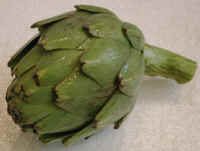
(Artichoke)
All commercially grown artichokes in the United States come from California,
particularly the central coast where cool summers and mild winters provide an
ideal growing area. The globe artichoke, a member of the composite family
of flowers, is closely related to the thistle. If left to flower, the
plants produce violet blossoms measuring seven inches across. The part we
eat is from the immature flower bud. The edible portion of the "globe" is
composed of the fleshy bases of the flower bracts (look like leaves) and the
receptacle to which the bracts are attached, commonly referred to as the
"heart." Artichokes can be purchased all year long, but the best quality
are available from March through May. Select artichokes that are dark
green, heavy for their size and blemish-free. The globe should be compact
and not beginning to open. Artichokes can be washed, placed in a plastic
bag, and stored in the refrigerator for several days until used. To
enlarge the photo and see the nutritional chart, click on the photo or link.
See Artichoke, Cooking and Eating

(Asparagus)
The parts of the asparagus that we eat are the sprouts. Once the asparagus
sprouts begin to branch out, the stems become very woody, and actually will grow
into a plant that looks like a little tree with small flowers and red berries.
Select asparagus that is firm, bright green, and still tender (not soft) at the
bottom and not dried out. The thickness of the stem will vary from 1/4 -
3/4 inch in diameter at the base. The thicker ones have a tendency to get
somewhat woody at the base, but the flavor is the same. It will store in
the refrigerator for a few days, but we usually try to eat it no more than two
days after purchase. When ready to use, before removing the market's
rubber bands from the bunch, we cut off about 1/2 inch from the bottoms.
See our asparagus recipe directory for
helpful suggestions. To enlarge the photo and see the nutritional chart,
click on the photo or link.

(Asparagus, White)
When we first saw white asparagus in the market, it attracted
our attention. The first thing we did was compare the package nutrition
information with that of regular green asparagus, and found that the white
asparagus was less nutritious. It was promoted as "gourmet white
asparagus", but after tasting it, we thought it would have better been promoted
as "novelty white asparagus". It has an earthy taste with very little of
the traditional asparagus taste. It is probably best cooked and served in
combination with green asparagus. See our
asparagus recipe directory
for helpful suggestions. We could not find complete nutritional information for white asparagus.

(Beans, Green)
The most commonly eaten fresh beans are the green beans, which
are also called snap beans or string beans. The outer green covering is an
edible bean pod. We enjoy them raw in salads or with dips, or cooked plain
or in other dishes. Select beans that are young (without large bulges in
the pod from maturing beans), firm, and bright in color and without blemishes.
The outer texture of the bean should feel velvety. See the nutritional
charts by clicking on the photo or link for raw and cooked green beans.

(Beans, Green, French Cut Frozen)
French cut green or string or snap beans, as they are interchangeably called is
a fancy name that describes beans that have been cut in half lengthwise. We like
to use French cut green bean in stir-fry and mix vegetable dishes because the
lengthwise cutting makes the cooked beans more flexible and easier to pick up
with a fork. Frozen French cut green beans are available in the frozen vegetable
section of most supermarkets. We have included nutritional information for both
microwaved and boiled cooked French cut green beans, which you can see by
clicking on the photo or link.
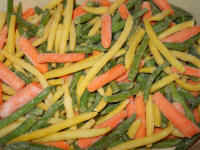
(Green and Yellow String Beans with Carrots, Frozen)
We are always on the lookout for different veggies, and the
packages of frozen green and yellow string beans with carrots caught our
eye. These specialty mixes are not always available, but they can be
substitutes with equal amounts of baby carrots, green beans, and yellow
beans. Since this is a blend of several vegetables, we don't have specific
nutritional information for this product.

(Beans, Dragon's Tongue) Dragon's
tongue beans are exceptionally crisp and juicy pods, that can be eaten
either raw or cooked. This Dutch wax bean bears large 6-8" cream-colored
pods with vivid purple mottling that fades when beans are cooked. Pods are
stringless and wide. We could not find any comprehensive nutritional
information, but in terms of nutritional value that we could find, dragon
tongue beans contain carbohydrates, fat, protein, fiber, selenium, iron,
folate, manganese, calcium, vitamin A, vitamin C, vitamin K, potassium, and
sodium.
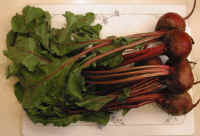
(Beets and Beet Greens)
The beets in this photo were purchased in bunches of three
beets each. They measure approximately two feet from the base of the roots
to the top of the leaves (greens). Since both the beet root and the leaves
are edible and nutritious, we purchase beets that have firm and undamaged roots
and leaves that are fresh with no sign of wilting. We eat beet roots and
greens raw in our salads and veggie drinks, as well as cooked in various ways
(see our beet recipes and information). To enlarge the
photo and see the nutritional information, click on the photo or link.

(Beets, Bull's Blood) As vegans, we don't
like the name of these beets, but bull's blood beets are very good eating.
Bulls blood is a rare beet variety, considered an heirloom vegetable and an
exceptional choice! With its sweet flavor, bulls blood is crunchy and delicious.
Bi-petal green leaves have a red vein leading into deep red stems, making an
eye-catching addition to your plate while adding layers of flavor to dishes. We
have not seen this variety in regular supermarkets, and purchased ours at Touch
of Dutch Farm in Richland Center, Wisconsin. We also could not find any
comprehensive nutritional information for these beets. The only information we
could find is that they contain potassium, fiber, vitamin A, folic acid, and calcium.

(Beets, Formanova) Formanova is a sweet
heirloom beet from Denmark. The literature says that it is famous for
slicing with its long, cylindrical roots, but we have never seen them in a
supermarket. We bought ours at Touch of Dutch Farm in Richland Center,
Wisconsin. These beets are a popular choice for slicing and processing, as
its roots make much more uniform slices than round beets and its skin slips
more easily after cooking. This tender and sweet variety is also known as "Cylindra"
and “Butter Slicer” because of its wonderful shape and texture. We could not
find any comprehensive nutritional information other than it is rich in
antioxidants.

(Beets, Touchstone Gold)
Touchstone is a fantastic, yellow-gold, beet that is considered the best
yellow beet available today. Round, smooth, golden roots retain their color
when cooked. Buttery, fine texture and sweet when eaten raw. Touchstone has
glossy green tops. Does not bleed like red beets. This is as sweet as a
table beet gets. We have not seen them in supermarkets, and purchased these
at Touch of Dutch Farm in Richland Center, Wisconsin. Touchstone gold beets
are an excellent source of folate, manganese, beta-carotene, and are a very
good source of potassium, copper, and fiber. They also contain magnesium,
phosphorus, vitamins B6 and C, and iron.

(Beets, Yellow) We have not seen yellow
beets on sale in any regular supermarket, but have seen them occasionally at
health food stores and some farm markets. We found references on the
internet that state that yellow beets date back to the 1820s or before, and
that they are sweet tasting and won’t bleed like red beets. We enjoy eating
them raw or cooked. The greens are also good to eat. Most of the other
information on the internet concerned recipes, and we could not find any
in-depth specific nutritional for yellow beets.
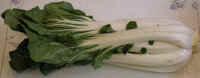
(Bok Choy)
Bok choy is also called Chinese mustard cabbage. It has a
mild flavor, and can be eaten raw in salads (like any cabbage), stir-fried, or
added to soups. A 100 gram (3-1/2 oz.) portion has only 13 calories.
See complete nutritional charts by clicking on the photo or link.
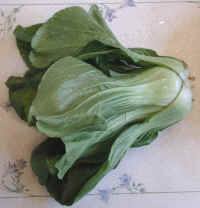
(Bok Choy)
This is a northern variety of bok choy that we purchased from a
local farmer in New York State. It is very tasty, with a stronger mustard
flavor in the green leaves than the store bought variety, which we understand
comes from California. The thickened base part of the leaves has the same
mild flavor of the California variety. In this variety the green color
extends down to the base, where as the California variety is white at the base.
This variety is great in soups and stir-fries. The only nutritional
information we have for Bok Choy is for the California variety.
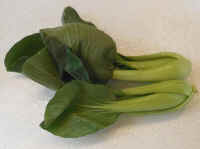
(Bok Choy, Baby) Baby bok choy are immature heads or bunches of bok choy that are harvested as a
specialty or gourmet item. Baby bok choy are more tender than mature bok choy,
which makes them great for cutting raw into salads. Since baby bok choy are
generally more expensive than mature, we have found that they are not worth the
difference in cost if we are cooking them, and we could not find any specific
nutritional information that would indicate that they have any more nutritional
value. When purchasing baby bok choy, choose ones that are free of blemishes or
are wilting. See Bok Choy for nutritional information.

(Bok Choy, Purple Lady) This variety
of bok choy originally came from China. We bought ours from Touch
of Dutch Farm in Richland Center, Wisconsin. It is a shorter and more open head
than the green variety we see in the supermarkets. The heads average only 6-7
inches tall. We could not find any in-depth nutritional information about this
variety other than it is antioxidant-rich. It is flavorful and is an excellent
culinary variety for cooking in a wok or eating raw in a salad. When purchasing
Purple Lady Bok Choy, choose ones that are free of blemishes or
are wilting. See Bok Choy for general nutritional information.

(Bok Choy, Suzhou Baby) Suzhou Baby is
a medium-sized bok choy that originally came from China. We bought ours from Touch of Dutch Farm in Richland
Center, Wisconsin. They have a crisp and tender head are tightly, and are great
for stir-frying. We could not find any comprehensive nutritional information,
but in general Bok Choy is high in several vitamins, especially C. When purchasing
Suzhou Baby Bok Choy, choose ones that are free of blemishes or
are wilting. See Bok Choy for general nutritional information.
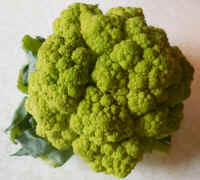
(Broccoflower)
Broccoflower is a cross between broccoli and cauliflower, of which there are
two species, this being the most popular. It is sometimes refered to as
green cauliflower. The California firm Tanimura & Antle trademarked the word
"Broccoflower" for the green cauliflower they market. When buying, select
only firm unblemished heads. Broccoflower is great raw in salads or dips,
and can be cooked by itself or in stir-fries, pizza, pasta premivera and
other recipes. We coluld not find any indepth nutritional information for
broccoflower, but we were able to find the following information for 100 grams of
broccoflower. See the nutritional chart by clicking on the photo or link.

(Broccoli)
Broccoli is the nutritional leader of the cruciferous family of vegetables,
which have been shown to help protect against colorectal, stomach and
respiratory cancers. We enjoy broccoli raw in our salads and for dips, or
cooked in stir-fries or in Italian dishes such as pizza and pasta prima vera.
When purchasing, select broccoli that is firm (crisp) and with dark green
florets. See the nutritional chart by clicking on the photo or link.

(Broccoli, Purple) Purple broccoli
develops large, silvery-green leaves on stiff stems growing in whorls around
a green central stalk. The plant produces a small, deep purple central head
made of tiny flower sprouts, and nearly a dozen similarly sized heads on
thinner stalks. Individual spears are harvested around 13 centimeters long
for bunching and to promote the growth of additional heads. Purple broccoli
offers a nutty, peppery flavor with the subtle sweetness and bitterness
common to all Brassica vegetables. Usually, purple broccoli is available in
the late winter and through the early spring months, but we purchased our
from Touch of Dutch Farm in Richland Center, Wisconsin in October. There are
several different named cultivars of Purple broccoli, including Bordeaux,
Claret, Nine Star, Red Arrow, Red Head and Red Spear. Purple broccoli is an
excellent source of vitamin C and a great source of vitamins K and A. It is
also a good source of folates,
B-complex vitamins, manganese and iron. Purple broccoli is a source of a
moderate amount of dietary fiber, potassium, protein, calcium, copper,
magnesium, and selenium, and contains trace amounts of zinc and sodium. It also
contains phytonutrients and flavonoids like lutein and zeaxanthin, which provide
beneficial antioxidants, and its purple color comes from anthocyanin, an
antioxidant compound that protects the plant and offers health benefits to
humans; however, with the high heat of cooking, it can lose its color.

(Broccoli Raab (Rabe) or Rapini)
Broccoli Rabe is a nutritious vegetable that is
related to the turnip and has a mustard-like flavor. It is not related to
broccoli, even though it has buds that look like broccoli. When purchasing, make
sure that the leaves are green and crisp. Rapini origins have been traced
to the Mediterranean region around Italy and to China, where it remains popular
in both of these nationalities cooking. We have included nutritional charts for
both raw and cooked broccoli rabe. As can be seen in these charts, this is
one of those vegetables that cooking releases more of the food value. To
enlarge the photo and see the nutritional charts, click on the photo or link.

(Broccoli Stir-Fry Mix, Frozen)
There are several brands and combinations of
frozen broccoli stir-fry mix sold in the markets. This particular one
contains (in order of quantity): broccoli, carrots, onions, red peppers, celery,
water chestnuts, and mushrooms, and was distributed by Aldi, Inc. in 1 pound
bags (2006 cost $0.89). We purchase this stir-fry mix primarily for
convenience in making "quickie" soups and stir-fry recipes.

(Brussels Sprouts)
Brussels sprouts are members of the cabbage family, which
they resemble in miniature form. They are a good source of dietary fiber
and protein, vitamins A and C, and potassium, iron and a small amount of
calcium. Like other cruciferous vegetables, Brussels sprouts have been
shown to have cancer prevention properties. When purchasing, select
tightly compact, firm heads with good color and without a strong odor. See
nutritional charts by clicking on photo or link.
Cabbage, Bok Choy - See Bok Choy
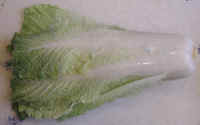
(Cabbage, Chinese)
Chinese or celery cabbage is a fairly mild tasting cabbage
that is great when eaten raw in a mixed green salad, or cooked in soup or
Chinese recipes. Select a Chinese cabbage that is crisp and free of wilted
or brownish leaf edges. Store Chinese cabbage in the vegetable drawer of
the refrigerator, where it will stay crisp for several days.
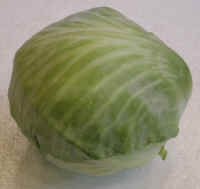
(Cabbage, Green)
We enjoy green cabbage either raw or cooked. It is a good
source of dietary fiber and vitamin C. Select heads that are firm and free
of harvesting damage (cuts, cracks, etc.) or worm holes. See the
nutritional tables by clicking on the photo or link.
Cabbage, Napa - See Napa
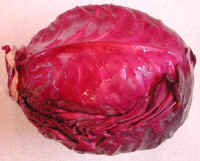
(Cabbage, Red)
We purchase our red cabbage in either supermarkets or farm stores
(when in season), and we always look for firm heads without discoloration or
imperfections. Red cabbage adds color to salads and cooked recipes.
Red cabbage leaves are colored dark red/purple. However, the plant changes its
color according to the pH value of the soil that it is growing in, due to a
pigment called anthocyanin. In acidic soils, the leaves grow more reddish,
while an alkaline soil they will produce rather greenish-yellow colored
cabbages. This explains the fact that the very same plant is known by different
colors in various regions. When we were children we used the juice of red
cabbage as a home-made pH indicator, turning red in acid and light greenish-blue
in basic solutions. On cooking, red cabbage will normally turn blue. To retain
the red color it is necessary to add vinegar or acidic fruit to the pot.
See the nutritional charts for raw and cooked red cabbage by clicking on the photo or link.

(Cabbage, Savoy)
Savoy cabbage has crinkly leaves and deep veining. We
have used savoy cabbage mostly for its appearance. Be careful when
selecting this variety of cabbage, as some of the heads can be quite tough.
Select firm heads with flexible leaves. See the nutritional information
for savoy cabbage by clicking on the photo or link.
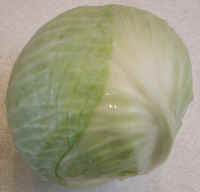
(Cabbage, White)
White cabbage is not really white, but light green in color.
The light color can easily be seen when set beside a green cabbage for
comparison. Many markets sell them interchangeably as "cabbage."
Select white cabbages that are crisp and firm with no signs of wilting,
blemishes, or cuts. White cabbage is great eaten raw in salads or cooked
in recipes. We could not find any specific nutritional information on
white cabbage, but suspect it is similar to green cabbage.
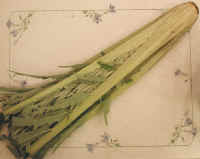
(Cardoon)
Cardoon is a perennial celery-like looking vegetable that is closely related to
globe artichoke, and is a member of the thistle family. It is prized by people
from the Mediterranean countries for its unique flavor, which we think is
similar to the taste of artichoke. We have found that cardoon is usually
only available in the markets around Christmas time. Many people discard
the tougher outer ribs, but we have found that they have excellent flavor, too,
if you don't mind throwing away the stringy remains, as one does with artichoke
bracts (leaves). All the ribs in this bunch are edible, as are the smaller
leaves. The new growth center stalks have a frilly top which is too tough to eat
and should be removed with the larger outer leaves. The inner tender
stalks can be eaten raw. Cardoon is best prepared by boiling in soups and
steaming. We have also stir-fried cardoon in water. See the
nutritional chart by clicking on the photo or link.

(Carrots)
Carrots are one of the staples in our diet. We use them raw as snack food,
in salads, with dips, in veggie drinks and even in some fruit smoothies.
Carrots are great in roasted veggies and in many other recipes. Select
carrots that are firm and free of mold or signs of rotting. Since most
carrots are sold in printed bags, it is important to look closely to make sure
the carrots are in good condition. Store carrots in the vegetable bin of
your refrigerator. See the nutritional charts for raw
and cooked carrots, and note the significant differences.
This is one of the vegetables in which cooking can increase some of the
nutritional attributes, and lower others. Our conclusion is that carrots
should be eaten both raw and cooked.

(Carrots, Baby)
There are two kinds of baby carrots: the true baby carrots which are picked before
they are matured, and the mature carrots that are cut into pieces and run
through a mechanical peeler that removes the skin and rounds the ends; they are
then washed, weighted and bagged. Mostly what we see in the supermarkets are the
baby cut carrots, which on the average cost about twice what whole carrots cost.
Baby cut carrots are usually produced from carrots that could not otherwise be
marketed due to size and imperfections, or they are specially grown to fill
market demands. We usually only buy these carrots for a traveling snack
food or when they are on sale. We also use them for a few specialty
recipes. Since they are really regular carrots, see the nutritional
information for Carrots.
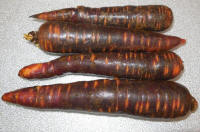
 (Carrots, Purple)
We found it very interesting that the purple carrot was
probably around for 4-5,000 years. Purple was the original color of carrots, and
the orange carrot that is common today, wasn't developed until the 17th century
in the Netherlands. We found that the taste of these purple carrots is similar
to the orange variety. We have only seen them available from some farm stores.
We could not find any nutritional information specifically for purple carrots,
so see the nutritional information for Carrots. To
the right is a cross section of a purple carrot.
(Carrots, Purple)
We found it very interesting that the purple carrot was
probably around for 4-5,000 years. Purple was the original color of carrots, and
the orange carrot that is common today, wasn't developed until the 17th century
in the Netherlands. We found that the taste of these purple carrots is similar
to the orange variety. We have only seen them available from some farm stores.
We could not find any nutritional information specifically for purple carrots,
so see the nutritional information for Carrots. To
the right is a cross section of a purple carrot.

(Cauliflower)
Cauliflower, like other members of the cruciferous family, have been shown to
protect against various forms of cancer. Such protection is also enhanced
by a vegan diet. Broccoli is excellent raw in salads or dips and cooked in
sweet and sour dishes. You might want to try our
Peas, Cauliflower and Tofu with Spicy Orange
recipe. Select cauliflower that is firm with white florets, without brown
spots. See the nutritional chart by clicking on the photo or link.
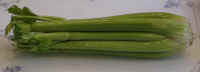
(Celery)
We enjoy celery either raw (in salads, as a snack, or with dips), or cooked (in
soups, roasted vegetable dishes, or in stir fries). Celery is very low in
calories, but has an interesting flavor which complements dishes. Select
celery that is firm and free of signs of decomposition (brown areas and soft
spots). See the nutritional charts by clicking on the photo or link.
Chard - See Swiss Chard
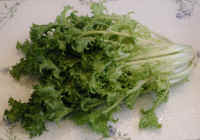
(Chicory)
Chicory, also called endive or curly endive, is a slightly bitter tasting salad
green, which is excellent for giving a mixed green salad a variety of tastes.
Chicory is also more "crunchy" than leaf lettuce, so that combining them
together gives the salad more "interest". When purchasing, select chicory
that is firm and crispy and has dark green leaves (see photo). See
nutritional chart by clicking on the photo or link.
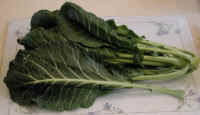
(Collard Greens)
Collard greens, also called collards, are a member of the
cabbage family of vegetables. Like other cruciferous plants, collards have
been shown to help protect against cancer, particularly for those on a vegan
diet. Collards have also been shown to help protect against macular
degeneration, an eye disease. Collard greens are "tough", so they are
usually cooked, either by steaming or by cooking in soups, curries, stir-fries,
or in casseroles. Occasionally, we add one or two stems and leaves to our raw
vegetable smoothies. Collards are one of the stronger tasting members of
the cabbage family. When purchasing, select collard greens that are crisp
and have dark green leaves. See our
Cooking Collard Greens recipe section. See the
nutritional charts by clicking on the photo or link.
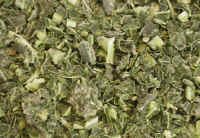
(Collard Greens, Frozen Chopped)
Frozen chopped collard green are an easy way
to have this vegetable available for "quickie" meal preparation. We
usually purchase our frozen collard greens in 1-pound plastic bags, which we can
store in the freezer for use anytime, such as in a vegetable smoothie, where we
only use a partial bag. By carefully opening the bag of frozen collard
greens from on end, and removing the amount of collard greens we wish to use, we
can then reseal the bag of still frozen greens and save the remainder in the
freezer for another meal. Frozen chopped collard greens are also available
in frozen blocks of 10-oz. and 3-pounds, which can only be used for one meal.
Collard greens, also called collards, are a member of the cabbage family of
vegetables. Like other cruciferous plants, collards have been shown to
help protect against cancer, particularly for those on a vegan diet.
Collards have also been shown to help protect against macular degeneration, an
eye disease. See our
Cooking Collard Greens recipe section. To
enlarge the photo and see the nutritional chart, click on the photo or link.
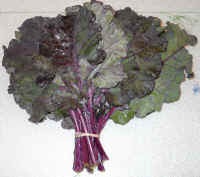
(Collard Greens, Purple (Collards))
We found these organic purple collard greens at a
local farm store. We have not seen them in any supermarket. They are very
tough to eat raw, as is the traditional green variety, but when steamed or
cooled in the microwave oven, purple collard greens soften nicely and in our
opinion are sweeter tasting than the standard green collards. Unfortunately,
we could not find any detailed nutritional informational for purple collard greens.

(Corn on the Cob - Bicolor)
Most people probably think of corn on the cob as
a vegetable, but it is really a grain. There are several common varieties
of corn on the cob: yellow, white, and mixed white and yellow, which is pictured
here. In our experience, we have seen only the yellow variety sold frozen
either on the cob or cut. We have found a variety of flavors in corn on
the cob depending on where it is grown and how long it has been since it was
harvested. The longer it has been since the corn was harvested, the more
bland the flavor, and the more "gummy" the texture. We have found it best
to buy only fresh corn on the cob that has a nice green husk.
We could not find any nutritional information for bicolor yellow and white corn
on the cob, but estimate that it should be somewhere in the middle of the
nutritional information we have for white corn on
the cob and yellow corn on the cob.
To enlarge the photo, click on the photo or link.

(Corn on the Cob - White)
Most people probably think of corn on the cob as a
vegetable, but it is really a grain. There are several common varieties of
corn on the cob: yellow, mixed white and yellow, and white, which is pictured
here. In our experience, we have seen only the yellow variety sold frozen
either on the cob or cut. We have found a variety of flavors in corn on
the cob depending on where it is grown and how long it has been since it was
harvested. The longer it has been since the corn was harvested, the more
bland the flavor, and the more "gummy" the texture. We have found it best
to buy only fresh corn on the cob that has a nice green husk. See the
enlarged photo and the nutritional chart for raw white corn on the cob by
clicking on the photo or link. We could not find any nutritional
information for cooked white corn on the cob, but it is probably very similar to
the differences between the raw and cooked information for
yellow corn on the cob.
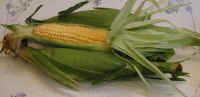
(Corn on the Cob - Yellow)
Most people probably think of corn on the cob as
a vegetable, but it is really a grain. There are several common varieties
of corn on the cob: white, mixed white and yellow, and the yellow, pictured
here. In our experience, we have seen only the yellow variety sold frozen
either on the cob or cut. We have found a variety of flavors in corn on
the cob depending on where it is grown and how long it has been since it was
harvested. The longer it has been since the corn was harvested, the more
bland the flavor, and the more "gummy" the texture. We have found it best
to buy only fresh corn on the cob that has a nice green husk. See the
nutritional chart by clicking on the photo or link.
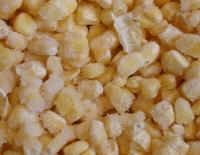
(Corn, Frozen)
We purchase frozen corn for convenience when we don't want to
eat corn-on-the-cob, or when it is out of season. Frozen corn is great for
use in soups, chili, and vegetable dishes. To enlarge the photo and see the
nutritional chart, click on the photo or link.

(Corn, Baby Canned)
We purchase canned baby corn occasionally as a specialty
item for salads, soups, and stir-fries to add a little variety.
Fresh baby corn has a crisp texture and a subtle, slightly sweet corn flavor.
Although almost all the baby corn found in the United States is pickled or
canned and imported from Asia, where the cost of labor is much lower. Baby
corn’s miniature size makes consumers think that it grows from dwarf corn
plants, but the tiny ears of baby corn are simply immature ears from
regular-sized corn plants. Specialty varieties are available for baby corn
production, but baby corn can also be harvested from many common corn varieties.
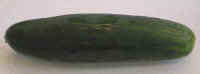
(Cucumber)
We enjoy cucumber raw in salads or with dips. Select cucumbers that are
dark green and firm, particularly on the ends. The slender ones generally
have smaller seeds. We prefer to buy cucumbers without the wax coating
that are available from farmers' markets in the summer and fall. If
unwaxed, we eat the skin, but if the cucumbers are waxed to prevent
decomposition, we peel off the skin before eating. See nutritional charts
by clicking on the photo or link.

(Cucumber, Armenian Yellow) The
Armenian Yellow Cucumber has a mild flavored, light green fruits that can
grow to enormous lengths, but are best when harvested at 5 to 12 inches.
Grows slender and curved with light green skin that turns yellow when fully
ripe, and is heavily ribbed. This one is 19 inches long. Botanically, the
Armenian yellow cucumber, isn't actually a cucumber, it’s a muskmelon. We
could not find any specific detailed nutritional information for this
variety of cucumber.

(Cucumbers, Dragon's Egg) Dragon's
Egg Cucumbers are a cream-colored fruit that is about the size and shape of
a large chicken egg! The literature says that they are mild, bitter free and
sweet tasting, but the ones we purchased from Touch of Dutch Farm in
Richland Center, Wisconsin still had some bitterness. This heirloom cucumber
originally came from Croatia. They are great for snacking and in salads. We
could not find any detailed nutritional information.

(Cucumber, English Seedless Burpless)
This dark green, thin-skinned cucumber is usually sold unwaxed and wrapped
in an airtight plastic wrap. The are often sold as English Cucumbers,
Seedless Cucumbers, Burpless Cucumbers, and even Greenhouse or Hothouse
Cucumbers; however, they do have seeds but they are undeveloped similar to
the seeds in a seedless watermelons. English cucumbers do not need to be
peeled; just slice them raw on a salad or eat as a snack, and are milder in
flavor. They are generally about 12 inches long and about 1 inch in
diameter, which is partly do to the growing process of having the cucumbers
grow on trellises where gravity helps keep the fruit long and narrow. They
are generally about twice the price of the regular supermarket variety.

(Cucumbers, Gele Tros) These Gele Tros
Cucumbers are also known as Large Dutch Yellow cucumber. This is a large
yellow cucumber that was popular in Holland for making yellow, sliced
pickles. The Dutch call this cucumber the “ancient race”. The ripe fruit are
quite colorful in their sunny yellow color. A fine old strain that is very
rare now even in Europe. We have not seen them in any supermarket or farm
store until we saw them at Touch of Dutch Farm in Richland Center,
Wisconsin, where we purchased them. We have only eaten them raw on our
salads, and they are crunchy and good tasting, with just a touch of
bitterness. We could not find any comprehensive nutritional information for
these cucumbers. Therefore, we suggest that
you look at the general nutritional information for cucumbers.
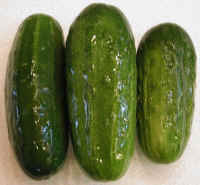
(Cucumbers, Kirby) Kirby cucumbers are
about half the size of a regular cucumber, with all the flavor of the
full-sized cucumber. Kirbies make the snappiest pickles and
they're also good raw. Their thin skin doesn't need to be peeled, if it is not
waxed, which they are not when purchased at farm stores. Just wash and eat, or
dice and toss with your favorite dressing in a salad. We rarely see Kirby
cucumbers in supermarkets. The ones we purchased are from a farm store, but they
are usually more expensive that the regular cucumbers. We could not find any
complete nutritional information for Kirby cucumbers. Therefore, we suggest that
you look at the general nutritional information for cucumbers.

(Cucumbers, Lemon) Lemon cucumber does not
have a lemon taste, only color, but has a thin, tender to crisp skin with a
flavor a little milder than a regular cucumber's. This tennis ball-sized
cucumber is a perfect serving for one or two people. It is believed to have
been introduced to the US in the late 1800s. We purchased ours at Touch of
Dutch Farm in Richland Center, Wisconsin. We could not find any
comprehensive nutritional information for this specific cucumber.

(Cucumbers, Natsu Fushinari)
This natsu fushinari variety od cucumber was developed to offer the flavor
and crispness of Japanese cucumbers with an easy-to-grow, single-stem
architecture. Many Japanese cucumbers are multi-stemmed, requiring steadfast
attention to manage the many side shoots. Natsu – meaning “summer” – brings
the high quality of the deep green, thin-skinned Japanese cucumbers with the
ease of summer. Natsu Cucumber is also parthenocarpic, meaning that it will
set fruit even without pollinators and can be grown indoors. An open
pollinated Japanese cucumber with terrific sweet flavour and small seed
cavity. Does well both outside and in the greenhouse. Is not prone to
powdery mildew. Very quick to germinate (2 days for root to emerge). In
Japanese, fushi means “node” and nari means “setting fruit.” We bought ours
at Touch of Dutch Farm in Richland Center, Wisconsin. We could not find any
comprehensive nutritional information.

(Cucumbers, Persian Pickling)
Persian Pickling cucumbers are small in size, averaging 10 to 15 centimeters
in length, and have a narrow, cylindrical appearance often with curved,
blunt ends. These are an heirloom variety which seem to be slightly smaller.
We have not seen these Persian pickling cucumbers in supermarkets, and
purchased these at Touch of Dutch Farm in Richland Center, Wisconsin. The
skin is thin, emerald to dark green, and tender, sometimes smooth or covered
in shallow ridges. Underneath the skin, the pale green flesh is dense,
aqueous, and firm with a succulent, crisp, and crunchy, snap-like
consistency. The flesh is characteristically crunchier and less watery than
other varieties, and the cucumbers release a faint green aroma when sliced.
Persian cucumbers have a mild, sweet, and vegetal taste without any
lingering bitter notes commonly found in commercial cucumbers. They can be
eaten raw as is or in salads, or pickled as the name implies. The only
nutritional information we could find says: Persian cucumbers are a source
of fiber to regulate the digestive tract, vitamin C to strengthen the immune
system, and potassium to balance fluid levels within the body. The cucumbers
also provide manganese and vitamin K to assist in faster wound healing,
antioxidants to protect the cells against damage caused by free radicals,
and other nutrients, including vitamin A, silica, iron, and calcium. Therefore, we suggest that
you look at the general nutritional information for cucumbers.

(Cucumbers, Sikkim) Sikkim cucumbers are
fat and can grow to several pounds in size. They have a greenish brown to
rusty red skin, sometimes with a whitish net design. They are good raw or
cooked. This cucumber variety is grown in the Himalayas of Sikkim and Nepal
where it originates from. We have not seen them for sale in supermarkets and
purchased these from Touch of Dutch Farm in Richland Center, Wisconsin. The
only nutritional information we could find for Sikkim cucumbers is they have
vitamin C, calcium and potassium.

(Daikon or Mooli)
Daikon is the Japanese name for this mild tasting large white radish, which
literally means "large root". The daikon in this photo was organically grown
in Eastern New York State, and is over a foot long. The supermarket
varieties are usually scrubbed clean, and are whiter. Wikipedia says, "In
the UK and continental Asia it is most commonly known as mooli." It is great
to eat raw in salads, or to munch on for a snack or for a dip. One of the
nice things about daikons is that they can be stir-fried with other
vegetables and they still retain their crispness much like water chestnuts.
We could not find detailed nutritional information on daikons, but did find
that a 30 gram serving of daikon has 1 gram of protein and 1 gram of
unsaturated fat for a total of 15 calories. They are also relatively high in
vitamin C with the 30 gram (1 ounce) serving providing 15% of our daily need.
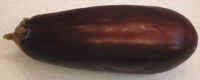
(Eggplant)
Eggplant comes in a variety of colors: white, yellowish-white, red, striped,
purple, and purple-black (as pictured), which is the most common variety.
Eggplant are high in fiber and potassium, with most of the fiber being contained
in the edible skin. Select eggplant that is firm with no wrinkles,
bruises, or soft spots. See nutritional chart by clicking on the photo or link.

(Eggplant, Black Beauty)
A beautiful vegetable with lovely, lavender blossoms
pretty enough to grow in the flower garden. 'Black Beauty' has set the standard
since 1902 for large, high-quality fruit. Outstanding when harvested at their
peak, the skin is tender, so no need to peel it. A widely used international
food; there are countless recipes from Italy to China to Russia and beyond. The
literature also says that they can grow as large as two pounds, but these from
Dutch of Dutch Farm in Richland Center, Wisconsin are smaller, but seem to have
the same quality. See Eggplant for nutritional
information.

(Eggplant, Japanese White) The
Japanese White Egg eggplant is a variety of eggplant that produces
oval-shaped, white fruits that are 2–3 inches in size. The fruits are known
for their smooth texture, rich flavor, and minimal bitterness. They are
often used in stir-fries, soups, and curries. The only nutritional
information we found was that a 100g portion contained: Total Fat 0.18g,
Total Carbohydrate 5.88g, Dietary Fiber 3.0g, and Protein 0.98g.

(Eggplant, Rosita) Rosita eggplant has a
lovely 8-inch x 4-inch neon, lavender-pink fruit that has a mild, sweet,
white flesh. The skin is tender and not bitter. Heirloom Rosita eggplant was
brought to the States from Puerto Rico in 1979, where it was developed
during the 1940s. We bought ours at Touch of Dutch Farm in Richland Center,
Wisconsin. We could not find any comprehensive nutritional information for
this variety of eggplant.

(Eggplant, Senshu Kinukawa Mizu)
This eggplant seems to have a variety of names. Mizunasu is a type of eggplant or aubergine found in Senshu, the southernmost
part of Osaka Prefecture. Measuring about 10-13 cm (4-5 in.) in length, mizunasu
have extremely soft, succulent flesh. Mizu means water, and this name reflects
the plant’s high water content. The vegetable can be eaten raw, thanks to its
soft skin and mild flavor, though most references say it should be cooked. To
enjoy the taste of mizunasu, cut off stem and calyx, score the top with
crosswise cuts, then split the eggplant vertically by hand. Mizunasu are also
popular as pickles, best enjoyed when plucked straight from the garden and kept
for just a few days in a mixture of fermented rice bran and brine called
nukadoko. Mizunasu are so sought-after, they are now cultivated in other parts
in Japan, but Senshu will always be considered their true home. We bought ours
at Touch of Dutch Farm in Richland Center, Wisconsin. We could not find any
comprehensive nutritional information for this variety of eggplant.

(Eggplant, Thai Green)
The Thai green eggplant is a small, round to elongated eggplant that is native to
Southeast Asia and is a staple of Thai and Southeast Asian cuisines. This is
more like the fatter elongated variety. Thai eggplants thrive in tropical
climates and have a tender skin and delicate flavor. Of the many varietals,
Thai green eggplant is the most popular and the one most likely found at
specialty Asian markets. We bought ours at Touch of Dutch Farm in Richland
Center, Wisconsin. The only nutritional information we could find says that
Thai eggplants contain dietary fiber, potassium, manganese, and
antioxidants.

(Eggplant, Turkish Orange) Ripe
Turkish orange eggplant, S. integrifolium, looks very much like a two inch
diameter tomato. We have also seen them referred to as Turkish Italian
orange eggplant, because of their popularity in Italy. They can be cooked
the same ways as other species of eggplant, and even put on veggie pizzas.
The only place we have seen them on sale is at farm stores, but they should
also be available at specialty produce markets. We could not find any
specific nutritional information for these orange eggplants.
Endive, curly - See Chicory

(Escarole)
Escarole is a broad-leaf endive that makes a nice addition to a mixed green
salad. In contrast to the leaf lettuces, escarole has a firm chewy texture
and a slightly bitter taste. Combined with milder-tasting lettuce,
escarole adds "interest" to a salad. Select heads that are crisp and
bright green. We could not find the nutritional chart information
specifically for escarole, but the nutritional chart for endive (general
category) appears to be fairly accurate for escarole, too. To view the
chart, click on the photo or link.
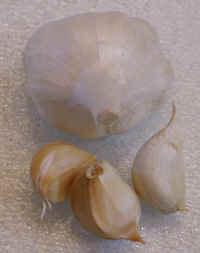
(Garlic)
Garlic has its origin in Europe, but is now grown throughout the world, as the
demand for its pungently flavored bulb has grown as an additive to cooking
delights. Garlic is a member of the lily family, as are onions.
Studies have shown that consuming about 10 cloves of garlic (or the oil from the
same amount of garlic) a day reduces blood cholesterol LDL (the bad type) and
increases the HDL (the good type). Our belief is that with a healthful
vegan (no animal products) diet, much less garlic would produce the same
results. See the nutritional chart by clicking on the photo or link.
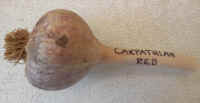
(Garlic, Carpathian) We could not
find anything about Carpathian red garlic, as labeled on the photo, but
there were many references to Carpathian Garlic, and some of the photos look
the same as the photo we have. Carpathian garlic is described as having a
rich strong flavor that has some heat and “spice� that lingers. Underlying
sweetness makes this a unique variety for roasting. Carpathian garlic
usually has anywhere from 8 or 9 easy to peel cloves that are of good size,
with no smaller inner cloves. Another reason that we believe that these are
one and the same garlic is because Carpathian garlic has thin bulb wrappers
that have a lot of purple and brown in them along with some reddish-orange
veins. We could not find any specific nutritional information for this garlic.

(Garlic, Polish Gem or Hardneck)
Polish Gem appears to be a growers name for this hardneck garlic, because we
could not find any references to Polish Gem garlic but did find several
references to Polish hardneck garlic which also looks like this photo. This
Polish garlic is described as a hardy, rich, garlicky, hot, strong porcelain
hardneck garlic. Polish garlic has 4-6 large cloves per bulb, which are
among the largest garlic bulbs. We could not find any specific nutritional
information for this garlic.
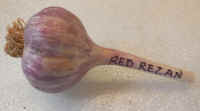
(Red Rezan Garlic)
Red Rezan garlic is a hardneck garlic that has medium heat, and holds up
well in cooking with only a little aftertaste. It is also said to have a
mild and complex flavor. We found the Red Rezan garlic at a vegfest and they
were grown by Braids 'n' Bulbs in Middleburgh, NY. We could not find any
specific nutritional information for this species of garlic.

(Garlic Scapes) Garlic scapes are the tender
stem and flower bud of a hardneck garlic plant. (Hardneck garlic is the kind
of garlic that typically grows in Canada and the northeastern U.S.) Scapes
first grow straight out of the garlic bulb, then coil. When harvested, they
look like long, curly green beans. We have not seen them in supermarkets and
bought ours at Touch of Dutch Farm in Richland Center, Wisconsin. We like
them in stir-fry recipes and steamed with greens. See limited nutritional
information below.
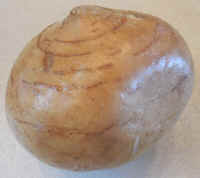
(Jicama)
Jicama or Yambean is also known as
a Mexican potato. The one in this photo has been waxed to preserve freshness in
the market, which is the reason for its shiny appearance. Jicama is a crunchy,
sweet, juicy tuber that is great to eat raw; just peel it and cut in strips or
cut into salads or eat them with dips. The label says that it is often paired
with chili powder, lemon, lime, oranges, ginger or even soy sauce. See the
nutritional chart (below) for more information.

(Kale)
Kale is a mild tasting member of the cabbage family, but does have a
somewhat bitter taste when eaten raw or in green smoothies. The smaller,
more tender leaves can be eaten raw in a mixed green salad. The larger
tougher leaves are usually steamed and eaten as a side dish, or cooked in
soups, casseroles, or stir-fries. We also eat some of the tougher leaves raw
in our vegetable "smoothies", which we make in our Vita-Mix. Like other
cruciferous vegetables, kale has been shown to help protect against cancer,
particularly for those on a vegan diet. Kale has also been shown to help
protect against macular degeneration, an eye disease. Select kale which is
firm and has dark green leaves. See
the nutritional chart by clicking on the photo or link.
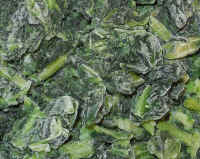
(Kale, Frozen)
Kale is a mild tasting member of the cabbage family, particularly when
frozen. Frozen Kale is a convenient way to have kale when it is out of
season, or when you don't want to take the time to clean and wash fresh
kale. We have purchased this washed, cleaned, and chopped frozen kale in 12
oz. steamable bags, 1 lb. bags, and 3 lb. food service bags. Frozen kale can
be used in any recipe calling for kale. Like other cruciferous vegetables,
kale has been shown to help protect against cancer, particularly for those
on a vegan diet. Kale has also been shown to help protect against macular
degeneration, an eye disease. See
the nutritional chart by clicking on the photo or link.

(Kale, Red)
Red kale is a mild tasting member of
the cabbage family. The smaller, more tender leaves can be eaten raw in a
mixed green salad. The larger tougher leaves are usually steamed or cooked
in soups, casseroles, or stir-fries. We also eat some of the tougher leaves
raw in our vegetable "smoothies", which we make in our Vita-Mix. Like other
cruciferous vegetables, red kale has been shown to help protect against
cancer, particularly for those on a vegan diet. Red kale has also been
shown to help protect against macular degeneration, an eye disease. Select
red kale which is firm and has dark reddish green leaves. We could not find
any specific nutritional information for red kale, but it should be similar
to the curly green kale, except that the red color
would indicate the presence of lutein.

(Kale, Russian)
This is a bunch of Russian kale direct from the farmers market (before washing and cleaning). The
leaves are softer than the curly kale, but has a slightly stronger flavor,
somewhat like a mild mustard green. It can be added raw to green smoothies,
and salads, or cooked in a variety of recipes. There is also a red variety
of Russian kale. We have not seen Russian kale for sale in the produce
section of regular supermarkets. We could not find any specific nutritional
information for Russian kale, but the literature we saw says that some
sources say it has less calcium, and perhaps a little oxalic acid (which is
also in spinach).

(Kohlrabi)
The name kohlrabi comes from the words "kohl" which means cabbage and "rabi"
which means turnip. This vegetable has a turnip shaped edible stem and
cabbage-like leaves. We have cooked the leaves in soups and eaten the stem
raw in salads and cooked in soups. When purchased, the leaves should not
be wilted and the stems should be firm. See the nutritional chart for
raw and cooked kohlrabi by clicking on the photo or link.

(Kohlrabi, Purple Vienna)
The only place that we have seen these
purple kohlrabi on sale is at the farm store in late spring. The name kohlrabi
comes from the words "kohl" which means cabbage and "rabi" which means turnip.
This vegetable has a turnip shaped edible swollen stem and cabbage-like leaves.
We have cooked the leaves by themselves or in soups and eaten the stems raw in
salads and cooked in soups. When purchased, the leaves should not be wilted and
the stems should be firm. These particular purple kohlrabi already had the
leaves removed when we purchased them. The literature says that the purple color
is mostly superficial, and that the nutritional value is very much the same as
non-purple kohlrabi.

(Kohlrabi, Purple Greens) We finally were able
to get a photo of the purple kohlrabi greens, which we purchased at Touch of
Dutch Farm in Richland Center, Wisconsin, but they didn't have the bulb
attached. These greens are very tasty. We cooked them with brown rice,
onions, lemon, pepper, and spearmint, with the coarsely diced bulbs that
were purchased separately. We could not find any specific nutritional
information for purple kohlrabi greens other than purple kohlrabi is high in
vitamin C and is a good source of both fiber and potassium. The
nutrient-dense stem also contains high amounts of phosphorus, magnesium,
calcium, and iron. The purple pigment in the skin of purple kohlrabi comes
from the presence of anthocyanins, which are antioxidants that can help
protect and boost the immune system.

(Lettuce, Buttercrunch) Buttercrunch
lettuce is a variety of lettuce with a buttery flavor and texture that's a
good choice for salads and wraps. It has a
sweet taste and resists heat, so it stays mild even in hot summers, and as the
name implies, it is somewhat crunchy. Some
references include buttercrunch as a type of Butter or Butterhead lettuce which
includes Boston and Bibb types, where we saw a composite nutritional analysis,
but there was no specific nutritional information for this specific variety.

(Lettuce, Green Gem) We first encountered gem
lettuce in our local supermarket as part of a 4-pack of petite lettuce from
Artisan®. Gem lettuce grows in broad compact heads with wide leaves, a
crunchy texture with a sweet flavor, which makes a nice addition to salads.
It also comes in a red variety. We could not find any specific nutritional
information for gem lettuce, other than that a 3-oz. serving provides: 10
calories, 2 grams of carbohydrate (less than 1 gram of which is fiber), 1
gram of protein, provides 100% of daily vitamin A, 10% vitamin C, 2%
calcium, and 4% iron.

(Lettuce, Red Gem) We first encountered
gem lettuce in our local supermarket as part of a 4-pack of petite lettuce
from Artisan®. Red gem lettuce grows in broad compact heads with wide
leaves, a crunchy texture with a sweet flavor, which makes a nice addition
to salads, including adding color. It also comes in a green variety. We
could not find any specific nutritional information for gem lettuce, other
than that a 3-oz. serving provides: 10 calories, 2 grams of carbohydrate
(less than 1 gram of which is fiber), 1 gram of protein, provides 100% of
daily vitamin A, 10% vitamin C, 2% calcium, and 4% iron.

(Lettuce, Iceberg)
Iceberg lettuce has its appeal in its convenience, but it is
the least nutritious of all salad greens. From a nutritional/economic
standpoint, it doesn't pay to buy iceberg lettuce. As an example, loose
leaf lettuce (also a sweet and delicately flavored lettuce) has: 58 times the
Vitamin A, 4-1/2 times the Vitamin C, 2-1/3 times the dietary fiber, and 3-1/2
times the calcium; and, romaine lettuce has even more Vitamin A and C. See
nutritional chart by clicking on the photo or link.

(Lettuce, Green Leaf)
Green leaf lettuce is a sweet and very delicately textured
and flavored lettuce. To add "interest" to our mixed green salads, we like
to combine green leaf lettuce together with some of the firmer and stronger
tasting greens, such as romaine, chicory and escarole. Select heads of
leaf lettuce that are bright green and with "firm" leaves (leaves that don't
flop over when the head is held upright). See the nutritional chart by
clicking on the photo or link.

(Lettuce, Red Leaf)
Red leaf lettuce is a sweet and very delicately textured and
flavored lettuce. To add "interest" to our mixed green salads, we like to
combine red leaf lettuce together with some of the firmer and stronger tasting
greens, such as romaine, chicory and escarole. Select heads of leaf
lettuce that are bright green and with "firm" leaves (leaves that don't flop
over when the head is held upright). Also, with red leaf lettuce, be
careful that the ends of the red leaves have not turned brown. See the
nutritional chart with green leaf lettuce,
which should be similar except for the phytochemicals that produce the red color.

(Lettuce, Oak) We first encountered oak lettuce
in our local supermarket as part of a 4-pack of petite lettuce from
Artisan®. Oak lettuce grows in broad loose heads with ruffled leaves. It has
a soft full texture with an enjoyable flavor, which makes a nice addition to
salads. It also comes in a red variety. We could not find any specific
nutritional information for oak lettuce, other than that a 3-oz. serving
provides: 10 calories, 2 grams of carbohydrate (less than 1 gram of which is
fiber), 1 gram of protein, provides 100% of daily vitamin A, 10% vitamin C,
2% calcium, and 4% iron.
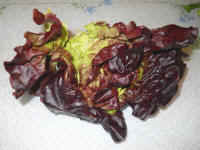
(Lettuce, Oak Red)
We first encountered red oak lettuce in our local supermarket
as part of a 4-pack of petite lettuce from Artisan®. Red oak lettuce grows in
broad loose heads with ruffled leaves. It has a soft full texture with an
enjoyable flavor, which makes a nice addition to salads. It also comes in an all
green variety. We could not find any specific nutritional information for red
oak lettuce, other than that a 3-oz. serving provides: 10 calories, 2 grams of
carbohydrate (less than 1 gram of which is fiber), 1 gram of protein, provides
100% of daily vitamin A, 10% vitamin C, 2% calcium, and 4% iron.
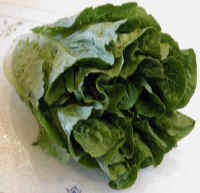
(Lettuce, Romaine)
Romaine lettuce is crispy, nutritious, and has a distinctive,
somewhat strong taste which we enjoy in our salads. Mixing the romaine
with leaf lettuce adds interest and blends nicely with the stronger taste of the
romaine. Select heads of romaine lettuce that are firm and with bright
green leaves. See the nutritional chart by clicking on the photo or link.

(Lettuce, Romaine Sunland) This is
very good tasting lettuce. We have not seen Sunland romaine lettuce in any
supermarket that we could identify as such. We bought this from Touch of
Dutch Farm in Richland Center, Wisconsin. Sunland Romaine Lettuce is a more
heat tolerant variety that stands out with its tall, upright leaves,
radiating a vibrant green from ribs of paler hues. Each crisp leaf offers a
satisfying crunch and slightly bitter undertone, typical of this esteemed
lettuce variety. The sturdy leaves hold up well to creamy dressings and are
a favorite choice for wraps and sandwiches, offering a contrasting texture
to softer ingredients. Perfect for health-conscious individuals, Romaine
lettuce is rich in vitamins A and K, folate, and dietary fiber, supporting
overall well-being while adding a fresh, nutritious crunch to meals. We
could not find any comprehensive nutritional information for this variety.

(Lettuce, Red Romaine) We found this red
romaine lettuce at a local farm store. It has a deep red color on the top of
the leaves, but the undersides of the leaves are green as seen in a few places in
this photo, such as in the upper right. The taste is similar to the regular
green romaine lettuce, but the red romaine adds a lot of color to any salad.
We mixed it with equal parts of green romaine. We could not find any
specific detailed nutritional information for red romaine lettuce.

(Lettuce, Summer Crisp) Summer
Crisp lettuce varieties are all hybrid plants. That means that you can't be
a frugal seed-saver, but the plants have been bred to be extremely heat
tolerant. Summer Crisp plants are also very slow to bolt and less resistant
to tipburn or rot. We have not seen it in any supermarket, and purchased this from
Touch of Dutch Farm in Richland Center, Wisconsin. This fragile lettuce in good
tasting and great in our salads. We could not find any comprehensive nutritional
information for summer crisp lettuce.

(Lettuce, Tango) We first encountered tango
lettuce in our local supermarket as part of a 4-pack of petite lettuce from
Artisan®. Tango lettuce has a somewhat strong and spicy flavor, which
makes a nice addition to salads. It also comes in a red variety. We could
not find any specific nutritional information for tango lettuce, other than
that a 3-oz. serving provides: 10 calories, 2 grams of carbohydrate (less
than 1 gram of which is fiber), 1 gram of protein, provides 100% of daily
vitamin A, 10% vitamin C, 2% calcium, and 4% iron.
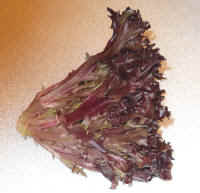
(Lettuce, Red Tango) We first
encountered red tango lettuce in our local supermarket as part of a 4-pack
of petite lettuce varieties from Artisan®. Red tango lettuce has a
somewhat strong and spicy flavor, which makes a nice addition to salads, as
well as adding some color. It also comes in a green variety. We could not
find any specific nutritional information for red tango lettuce, other than
that a 3-oz. serving provides: 10 calories, 2 grams of carbohydrate (less
than 1 gram of which is fiber), 1 gram of protein, provides 100% of daily
vitamin A, 10% vitamin C, 2% calcium, and 4% iron.
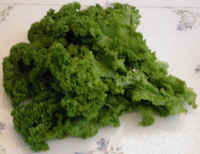
(Mustard Greens)
The mustard greens in this full-sized photo are approximately
two-thirds actual size. Mustard greens have a distinctive, strong, bold
taste. Because of this strong taste, we prefer cooking them with other
greens to get a variety of flavors. Choose mustard greens that are crisp
(not wilting) and that do not have brown tips on the leaves. See the
nutritional chart by clicking on the photo or link.
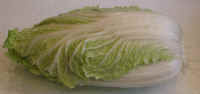
(Napa)
Napa cabbage is the most popular family of Chinese cabbages seen in the supermarkets
of the West and East. When matured, the plant forms a head with leaves and petioles.
This head-forming vegetable is very tender and delicious whether eaten raw, in
salads, or cooked. It is also the least nutritious of the Chinese
cabbages. We could not find the nutritional data for the raw vegetable,
but the nutrition chart for cooked napa can be seen by clicking on the photo or
link. Compare this chart with that of bok choy
to see the differences.
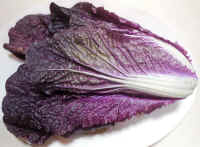
(Napa, Red, Cabbage) Red napa cabbage is a very new variety of
Chinese cabbage that was developed by the Kwonnong Seed Co., LTD. and
released in 2016. We first saw it in a supermarket in 2017. Red napa cabbage
is also known as red Chinese cabbage, and is botanically classified as
Brassica rapa subsp. pekinensis. The name “napa” comes from a Japanese
colloquialism referring to any type of leafy vegetable. Over time, it has
come to be used to describe this particular variety of Chinese cabbage. Napa
cabbage is sometimes referred to as Pe-tsai or celery cabbage in Asia. The
literature says that the flavor of red napa cabbage is slightly different
than that of the green napa cabbage variety; it is mild and sweet, not
bitter like many other red cabbage varieties, but we didn't think it was
much sweeter than the green variety; however, it tasted good and we ate it
raw in a tossed salad where the purple color really brightened up the salad.
We could not find complete nutritional information for red napa cabbage, but
the literature on the internet says that it is rich in vitamins C and A, as
well as zinc and calcium. The deep burgundy or purple color of red napa
cabbage is due to the presence of anthocyanins, phytonutrients responsible
for pigment in fruits and vegetables, which also serves as a powerful
antioxidant, and this makes it more nutritious than the green variety.

(Okra, Frozen)
Fresh okra should always be as green as the okra in this
photo. Unfortunately, we rarely see fresh okra in the markets; and when we
do, most of it is turning brown, so we usually buy frozen whole or cut okra.
Okra, also called lady fingers, or bhindi in Indian cuisine is a plant grown for
its fibrous pods full of round, white seeds. Okra originated somewhere
near present-day Ethiopia. Okra is great in soups and in a variety of
other dishes. The high fiber content helps to thicken soups and sauces. To
enlarge the photo and see the nutritional chart, click on the photo or link.

(Okra, Frozen, Cut)
Fresh okra should always be as green as the okra in this
photo. Unfortunately, we rarely see fresh okra in the markets; most of it
is turning brown, so we usually buy frozen whole or cut okra. Okra, also
called lady fingers, or bhindi in Indian cuisine is a plant grown for its
fibrous pods full of round, white seeds. Okra originated somewhere near
present-day Ethiopia. Okra is great in soups and in a variety of other
dishes. The high fiber content helps to thicken soups and sauces. To
enlarge the photo and see the nutritional chart, click on the photo or link.
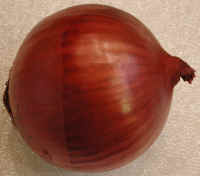
(Onion, Red)
The red onion is one of the sweeter varieties, though we have had
some that were quite strong. We generally use red onions to add color in
salads or as slices for sandwiches. Choose red onions that are firm with
no soft spots, particularly on the stem end. We could not find any
specific nutritional data for red onions. See the nutritional chart for
yellow onions.

(Onions, Australian Brown)
The Australian brown onion has a medium sized flattened bulbs, that is
flavorful and pungent, with a skin that is yellow brown in color. This
variety stores extremely well. It was introduced in 1897 by W. Atlee Burpee.
It has also been described as a Spanish type onion. We purchased ours from
Touch of Dutch Farm in Richland Center, Wisconsin. We could not find any
comprehensive nutritional information for this specific onion.
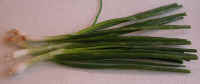
(Onions, Scallions)
The scallion is the first growth from an onion seed.
It is harvested as soon as it has nice green leaves and before the bulb begins
to develop. Scallions are delicious raw as pictured and used for a veggie
dip, cut as an addition to a tossed salad, or cut and sprinkled on soups and
Chinese dishes. Select scallions that have bright green, crisp leaves.
If fresh when purchased, they will last almost a week in the vegetable bin of a
refrigerator. See the nutritional chart by clicking on the photo or link.

(Onions, Spanish)
Spanish onions are considered to be one of the milder
varieties of onions, but we have found that the "sharpness" can vary quite a
bit. They are a large onion and are excellent for making sandwich slices.
Spanish onions are members of the lily family as are all other onions and
garlic. The nutritional values of onions are similar, so we suggest that
you choose your onions primarily by flavor and serving appearance. See
nutritional chart by clicking on photo or link.

(Onions, Vidalia) We love
the consistently sweet taste of raw Vidalia onions on our salads and on
sandwiches, but we do not consider then worth the higher cost for cooked
recipes, as all varieties of onions seem to sweeten with cooking. We find them
in the markets beginning in late spring, and only purchase them when they are
firm, and free of mold or rotting. According to the literature, this sweet taste
results from growing them in the low sulfur content soils in the Vidalia area,
and surrounding counties of Georgia, which according to the law is the only
state that they can be grown in and have the name "Vidalia". These requirements
go even further and state that Vidalia varieties include the hybrid yellow
granex, varieties of granex parentage, or other similar varieties recommended by
the Vidalia Onion Committee and approved by the U.S. Secretary of Agriculture.
The onions were first grown near Vidalia, Georgia, in the early 1930s. Mose
Coleman is considered the person who discovered the sweet Vidalia Onion variety
in 1931. We could not find specific nutritional information for Vidalia onions,
probably since it is considered more of a brand name than a variety, thus we
have included the nutritional information for sweet onions.

(Onions, White Sweet)
We purchased these three inch diameter white sweet onions
at a local farm store, where they were sold freshly harvested with the green
tops and roots still attached. Later in the season they continued to sell
them, but without the tops and roots, just as they would look in the
supermarket. These white sweet onions are mild tasting and great eaten raw
in salads and sandwiches. Select white sweet onions that are firm to the
touch, particularly at the stem end, which is usually where the first signs of
spoilage begin. Also make sure there are no signs of mold, which is
usually black. See the nutritional chart by clicking on the photo or link.

(Onions, Yellow)
Yellow onions are considered a utility or cooking onion,
though we also enjoy them raw in salads and on sandwiches. They are a more
"spicy" variety. Yellow onions, like all other onions and garlic, are
members of the the lily family. See the nutritional chart by clicking on
photo or link.
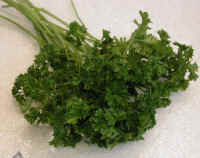
(Parsley, Curly)
We have not found much difference between the flavors of
curly and straight parsley. We generally buy whichever is fresher and less
expensive; however, this curly variety is more decorative, if that is a factor.
Select crisp bunches (not wilted) with a bright green color. We eat curly
parsley raw in our salads, in our raw vegetable smoothies, or cooked in various
dishes for added flavor. See the nutritional chart by clicking on the
photo or link.

(Parsley, Straight or Italian)
We have found very little difference in the
flavor between this straight or Italian variety of parsley and the curly
variety. Parsley is a great addition to salads and for adding flavor to
many dishes. Choose parsley that is crisp (not wilting) and green with no
brown edges. We could not find any specific nutritional data for the
straight or Italian parsley. See the nutritional chart for curly parsley.
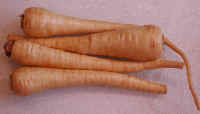
(Parsnips)
We occasionally buy parsnips for cooking in soups. Their flavor is
somewhere between carrots and turnips. We see most parsnips being sold in
printed plastic bags. Look carefully to make sure they are free of mold
and rot. Parsnips are much less nutritious than the carrots they resemble
in shape. See the nutritional chart for both raw and
cooked parsnips.

(Peas, Green) Peas are the small spherical
seeds, or the seed-pods of the legume, Pisum sativum. Each pod contains several
peas (raw seeds). Although peas are botanically a fruit, as are all legumes,
they are treated as vegetables in cooking. Only about 5% of the peas grown are
sold fresh; the rest are either frozen or canned. Frozen peas are preferable to
canned peas as they retain their flavor and have lower sodium content. We
usually buy frozen peas for convenience, but fresh green peas in the pod are
nice to buy locally when they are in season. See the nutritional chart for
raw and cooked green peas by clicking on the photo or link.
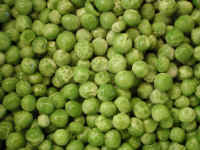
(Peas, Green Frozen)
For convenience, we usually buy frozen peas.
Frozen peas retain their color, flavor and nutrients better than canned and are
lower in sodium. They are great in vegetable soups and a variety of
other dishes, or served as a side dish. See the nutritional chart below.

(Peas, Snap)
The nice thing about snap peas is that they have an edible pod,
much like green string beans. Snap peas are great eaten raw or in
stir-fries or other recipes. The only thing that is necessary to prepare
snap peas is to wash them and snip off the stem end. Select snap peas that
are crisp, bright in color, and free of blemishes. To see the nutritional
information, click on the photo or link.

(Peas, Honey Snap II Sugar Snap)
This eye-catching yellow snap pea was developed by the late Dr. Calvin
Lamborn, the father of the snap pea and breeder of the classic Sugar Snap.
They are delicious raw in salads, dips, or just to snack on. They are also a
great addition to a stir-fry. We have not seen these in supermarkets, and
bought ours from Touch of Dutch Farm in Richland Center, Wisconsin. We could
not find any nutritional information for this variety of snap peas.

(Peas, Royal Snap II Sugar Snap)
This eye-catching deep purple snap pea was developed by the late Dr. Calvin
Lamborn, the father of the snap pea and breeder of the classic Sugar Snap.
They are delicious raw in salads, dips, or just to snack on. They are also a
great addition to a stir-fry. We have not seen these in supermarkets, and
bought ours from Touch of Dutch Farm in Richland Center, Wisconsin. We could
not find any nutritional information for this variety of snap peas.

(Pepper, Banana)
The approximately six inch long banana pepper is one of the
mildest of the hot peppers. Most of the "heat" of the banana pepper seems
to be concentrated in the stem end and seeds. Select banana peppers that
are firm and free of blemishes and wrinkles. Banana peppers are great in
sauces and stir-fries because they add both the pepper taste and a little
spiciness. We could not find any specific nutritional information on the
banana pepper.

(Pepper, Green Bell)
Green bell peppers are the most popular of the peppers,
because of their mild flavor. They are a good source of Vitamins A and C,
but the mature red bell peppers are even better. Green bell peppers are
good either raw or cooked. See the nutritional chart by clicking on photo
or link.

(Pepper, Orange Bell)
Orange bell peppers are considered to be a hybred pepper. We have not seen
then at farm markets and rarely in suppermarkets, except Aldi's does offer a
3 pack of red, orange, and yellow bell peppers at a premium price. One of
the things we noted by looking at a comparison between the various colors of
bell peppers is that the orange bell pepper has thick flesh and is much
sweeter than the green, but it is not as sweet as the red ones. The orange
one generally is more expensive than the green. However, it is not as
expensive as the red, which is due to the degree of ripening. We could not
find any nutritional information for this orange variety of bell pepper,
though we believe it should be somewhere between that of the yellow and the
red.
(Pepper, Red Bell)
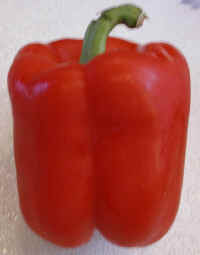
Red bell peppers are the mature form of green bell peppers.
They have a sweet flavor, and probably would be even more popular than the green
ones, it it wasn't for their price. Red bell peppers are an excellent
source of vitamins A (9 times higher than green bell peppers) and C (more than
double green bell peppers). See the nutritional chart by clicking on photo or link.
(Pepper, Yellow Bell)
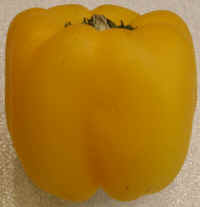
We generally buy yellow bell peppers to add color and
pepper flavor to our salads, veggie dips, and sometimes to our cooked dishes.
Like the other bell peppers, this yellow variety is also high in vitamin C.
See the nutritional chart by clicking on photo or link.

(Peppers, Buena Mulata) A very rare,
extremely productive, and stunning hot pepper being offered exclusively
through Baker Creek! William Woys Weaver introduced us to this
pepper from his grandfather's collection. His grandfather received the pepper
from African-American painter Horace Pippin in 1944. A chameleon-like cayenne
(Scoville units: 30,000 to 50,000) pepper that undergoes color changes during
ripening; from violet to pink, then orange changing to brown, and eventually to
a deep red. The long, round pods reach 6 to 7 inches in length and undergo a
unique flavor change as they ripen, with the reds being more sweet and meatier
than the violet. The stunning plants also make wonderful potted specimens. We
bought ours at Touch of Dutch Farm in Richland Center, Wisconsin. We could not
find specific nutritional information for this variety.
(Peppers, Cayenne)
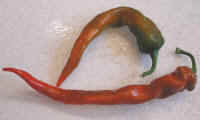
Cayenne peppers are mostly used in cooking hot-spicy dishes. They can be used fresh and
finely chopped or ground in a blender for adding to chilies, curries, or other
spicy recipes. Cayenne pepper is usually sold as a powder or in a thin,
vinegar-based sauce (hot sauce). It is generally rated at 30,000 to 50,000
Scoville Units. When young and green, they are less hot. The hotness produced by
cayenne peppers is caused by its high concentration of a substance called
capsaicin. Technically referred to as 8-methyul-N-vanillyl-6-nonenamide,
capsaicin has been widely studied for its pain-reducing effects, its
cardiovascular benefits, and its ability to help prevent ulcers. Capsaicin also
effectively opens and drains congested nasal passages. We could not find any
nutritional information for whole cayenne peppers; however, you can see the full
nutritional chart for ground cayenne pepper.

(Peppers, Cheese, green)
Cheese peppers are also called bull-nosed peppers.
They are simply a strain of bell pepper that has an extra-thick wall and a
flattened shape. They are a superb all-round pepper for eating raw or cooking.
We purchased this pepper at a farm store, and have not found them in
supermarkets. We could not find any specific nutritional information for
cheese peppers, but believe it should be similar to
Pepper, Green Bell.

(Peppers, Cheese, red)
Cheese peppers are also called bull-nosed peppers.
They are simply a strain of bell pepper that has an extra-thick wall and a
flattened shape. They are a superb all-round pepper for eating raw or cooking.
We purchased this pepper at a farm store, and have not found them in
supermarkets. Red cheese peppers are green peppers that have fully
ripened. We could not find any specific nutritional information for cheese
peppers, but believe it should be similar to Pepper, Red Bell.

(Peppers, Hungarian)
Hungarian peppers are among the mildest of the hot peppers.
The average length of the Hungarian peppers is about five inches. Their
mid cross section is oval shaped, but they are round at the top. They are
great in stir fries and sauces, adding both the pepper taste and some spiciness.
Select Hungarian peppers that are firm and free of soft spots, blemishes and
wrinkles. See the nutritional chart by clicking on the photo or link.

(Peppers, Hungarian Black) These
pepper plants are highly ornamental. The peppers are good to eat raw or
cooked. Hungarian black peppers grow to 4" long. The fiery fruits of this
early-to-mature pepper resemble jalapeños in shape, but their spiciness only
when these shiny black peppers eventually ripen to red. The spicy heat of
these peppers range from about 2500-10000 Scoville units. The prolific
plants grow to 3' tall and produce green foliage highlighted by dark-purple
veins alongside beautiful purple flowers. We have not seen them in
supermarkets and purchased ours at Tough of Dutch Farm in Richland Center,
Wisconsin. We could not find any comprehensive nutritional information for
these peppers.
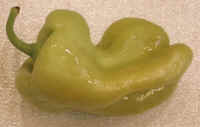
(Peppers, Italian Green)
The Italian sweet green pepper is a variety of the species
Capsicum annuum, like bell peppers and chili peppers. It has the appearance of a
combination of a tapered bell pepper and that of a large chili pepper, but it
has the mild taste of sweet peppers such as the bell pepper. They are sold
in many large supermarkets and in many farm stores. Select only firm peppers
without blemishes. They are great eating raw in salads or cooked. To
enlarge the photo and see the nutritional chart click on the photo or link.
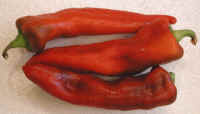
(Pepper, Italian Red)
The Italian red peppers grow to a length of six to eight
inches. They are wonderful eaten raw in strips or in salads. In our
opinion, they are better tasting than the red bell peppers. The red
Italian pepper adds color to many cooked recipes, but we believe that cooking
them is a waste of their wonderful raw flavor. Select Italian red peppers
that are firm and free of blemishes and wrinkles.
To enlarge the photo and see the nutritional chart click on the photo or link.

(Peppers, Italian Long Hot)
Italian Long Hot peppers are a type of chili pepper that are long, skinny,
and slightly wrinkled. They are known for their sweet, mild flavor with a
smoky taste when charred. They are a staple in Italian American cooking and
can be used in many dishes. They have a tangy flavor and an unpredictable
heat level in the range of 100 to 1000 on the Scoville heat unit (SHU) scale
when harvested green, but when harvested in their fully ripened red stage,
their heat level can be in the 30,000+ (SHU). The ones we bought at Touch of
Dutch Farm in Richland Center, Wisconsin are in the higher heat level.
We could not find any specific nutritional information for this variety.

(Pepper, Jalapeno)
The jalapeno pepper is probably the best known of the
chili peppers. On the "heat index" of hot peppers, the jalapeno is
relatively "mild". Jalapeno peppers are about two to three inches in
length and are mostly green or with a red blush. Select jalapeno peppers
that are firm and free of bruises, blemishes, and wrinkles. They will
store in the refrigerator for about a week, however, it is best to uses them as
soon as possible or process them into
Pickled Jalapeno Pepper Slices for future use on
sandwiches and pizzas.

(Pepper, Jalapeno Orange Spice)
Orange spice jalapeno peppers are a colorful new heirloom introduced by New
Mexico State University (a crossing of the permagreen bell pepper with the
early jalapeno pepper bred by New Mexico State University. This vibrant,
tangerine-orange variety is extra tasty and makes an amazing salsa. Super
ornamental and extremely prolific, these have a wonderful fruity-citrus
taste and are packed with nutrition and some serious heat. A gourmet treat
that adds flavor to the jalapeño family! Another important fact about these
peppers is that they have a heat index of +/- 79,000 SHU compared to that of
regularly sold jalapeno peppers of 5-10,000 SHU. We bought ours at Touch of
Dutch Farm in Richland Center, Wisconsin. Even though the literature says
that they are packed with nutrition, we could not find any specific
nutritional information for this variety.
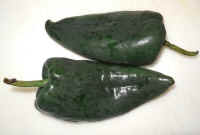
(Pepper, Poblano) Poblano peppers are a
milder tasting Mexican chili pepper, which usually are harvested green and
have a 500 to 1500 rating on the Scoville scale. Some sources rate them
higher at 1000 to 2000, and we believe that these rating must be without the
seeds, which are much hotter, as are the fully ripe red peppers. We have
eaten them raw in salads and dips, cooked with roasted veggies, and roasted
on sandwiches. Some people peel the skin off after roasting. They are very
popular in Mexico and in Southwester United States. Dried poblano peppers
are also sold as Ancho chiles.

(Pepper, Sugar Rush Peach)
The sugar rush peach pepper comes from the Capsicum baccatum species of
peppers. This species has origins in either Peru or Bolivia. Commonly
referred to as aji peppers, they are now cultivated across South America and
in Costa Rica, as well as in other parts of the world. We bought ours at
Touch of Dutch Farm in Richland Center, Wisconsin. The long, peach-colored
fruit is packed with loads of super sweet, tropical flavor, and the seeds
bring a smoky, complex heat that when used together, creates a wild flavor
experience. Decently hot, more than a jalapeno but less than a habanero.
Most of the heat of this pepper resides in the interior ribs. We could not
find comprehensive nutritional for these peppers other than they contain
vitamins A and C, as well as copper and potassium.
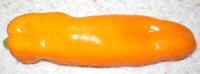
(Pepper, Sweet Long Orange)
This sweet long orange pepper is a greenhouse developed and grown variety.
It tastes like an orange bell pepper, but has fewer seeds and a slightly
thicker orange flesh. The cost of these peppers is very similar to that the
other colored bell peppers in the supper market. We could not find any
specific nutritional information for this variety, but we believe that it
should be very similar to that of bell peppers.
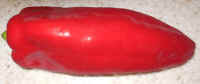
(Pepper, Sweet Long Red)
This sweet long red pepper is a greenhouse developed and grown variety.
It tastes like an red bell pepper, but has fewer seeds and a slightly
thicker red flesh. The cost of these peppers is very similar to that the
other colored bell peppers in the supper market. We could not find any
specific nutritional information for this variety, but we believe that it
should be very similar to that of bell peppers.

(Pepper, Sweet Long Yellow)
This sweet long yellow pepper is a greenhouse developed and grown variety.
It tastes like an yellow bell pepper, but has fewer seeds and a slightly
thicker yellow flesh. The cost of these peppers is very similar to that the
other colored bell peppers in the supper market. We could not find any
specific nutritional information for this variety, but we believe that it
should be very similar to that of bell peppers.
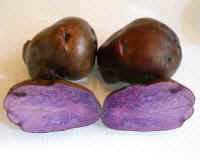
(Potatoes, Adirondack Blue) The
only place that we have found these Adirondack blue potatoes for sale is at
farm stores. The Adirondack blue potato is a hybrid variety that was
developed by Cornell University, and released in 2003. Other references say
that the Solanum tuberosum Adirondack blue potato originated in South
America. It is a great potato to add color to any meal, including salads.
They do no discolor while baking or boiling. If not being used for mashing,
we suggest boiling and baking the potatoes with the skin on. The skins also
add nutritional value. We could not find specific nutritional information
for these potatoes.

(Potatoes, Adirondack Red)
We first encountered these Adirondack red potatoes in a local farm store.
They are good tasting and can be prepared in any way you desire, but we
prefer baking them in pre-cleaned skins to show off their beautiful color
(since the skins are thin, we need to be careful to scrub them gently so
as not to remove the skin). Wikipedia says that the Adirondack red potato is
a hybrid potato variety with red flesh and skin, bred by Cornell University
potato breeders Robert Plaisted, Ken Paddock and Walter De Jong and released
in 2004. Adirondack Red potato tubers are unusual because both the skin and
the flesh are colored and have high levels of anti-oxidants. They are
described as "Early-to mid-season, medium-to high-yielding variety. Dark
green decumbent to spreading vines bear oblong to long, slightly flattened,
purplish-red-skinned tubers with shallow eyes and pink to red flesh."

(Potatoes, French Fingerling)
French fingerling potatoes are small to medium size fingerlings and are
slender and cylindrical in shape with rounded ends, averaging 6-7
centimeters (2.5 inches) in length. The rose-colored skin is thin and smooth
with some shallow eyes and brown spotting scattered across the surface. The
flesh is firm, dense, slippery, and is a marbling of pink and ivory. French
fingerling potatoes stay firm and waxy when cooked and offer a robust,
earthy, nutty, and buttery flavor. We cook them with the skin. The French
fingerling potato was developed and released commercially in France in the
1950’s, where it was created from a cross between the rosa and vale
potatoes. We found them at a vegfest and they were grown by Braids 'n' Bulbs
in Middleburgh, NY. We could not find any specific nutritional information
for the French fingerling potatoes.

(Potatoes, Red)
Red potatoes are so named because of their red skins. If
the skin is peeled off, red potatoes look quite similar to standard white
potatoes. Select red potatoes that are firm and free of cuts, bruises, or
any signs of mold. When we are using red potatoes, we thoroughly wash them
and leave the skins on to add color to the recipe we're preparing. In our
opinion, since red potatoes are generally more expensive than white potatoes, it
doesn't pay to buy them if you're going to peel them. To enlarge the photo
or see the nutritional chart, click on the photo or link.

(Potatoes, Red Thumb Fingerling)
Red Thumb fingerling potatoes are small in size, tubular, and oblong in
shape, and they average about 6-7 centimeters (2-1/2 inches) in length. The
semi-smooth skin is ruby red with a few shallow eyes, brown russeting, and
some dark brown spots dispersed across the surface. The potato flesh is
marbled with pink and creamy white and is waxy and firm. When cooked
with removing the skin, Red Thumb fingerling potatoes have a uniform shape
and are creamy with an earthy, buttery flavor. Red potatoes are believed to
have originated in Peru, and the Red Thumb fingerling is a modern variety
that is said to resemble some of these original red potato cultivars. These
small potatoes contain iron, vitamin C, zinc, copper, potassium, and fiber.
We found them at a vegfest and they were grown by Braids 'n' Bulbs in
Middleburgh, NY.
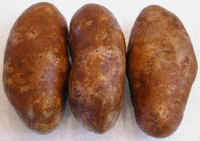
(Potatoes, Russet)
The russet is one of the largest of the potatoes available in
the markets. They are ideal for baking, stuffing, and even for making a
potato pizza (without the traditional dough
crust). We have found that russet potatoes generally cost more than white
potatoes, so we usually buy them only for baking with their skins intact.
For this reason, select russet potatoes that are free of blemishes and damage so
that portions don't have to be cut out prior to baking. The russet
potatoes in the photo are slightly over six inches in length, and the one in the
center of the photo is standing on its side. See the nutritional
chart for russet potatoes baked with their skins.

(Potatoes, Russian Banana Fingerling)
Russian Banana fingerling potatoes are small in size and are oblong,
slender, and crescent in shape, averaging 6-7 centimeters (2.5 inches) in
length. The skin is khaki-colored with many light brown spots freckled
across the surface and a few, medium-set eyes. The skin is also waxy,
exceptionally smooth, and so thin that it is rarely peeled. The yellow to
gold flesh is soft, dense, and moist. When cooked, Russian Banana fingerling
potatoes are fluffy and have a full-bodied, buttery, and nutty taste. The
Russian Banana fingerling cultivar was developed in Europe’s Baltic region
in the 1700’s. We found them at a vegfest and they were grown by Braids 'n'
Bulbs in Middleburgh, NY. We could not find any specific nutritional
information for these potatoes.

(Potatoes, Sweet)
Sweet potatoes have either a dry light yellow or moist deep
yellow or orange flesh. The darker colored sweet potatoes are sometimes
called yams, which is a misnomer, as true yams are grown only in the tropics.
We enjoy sweet potatoes baked, in roasted vegetable dishes, and in curries.
Select potatoes that are firm and free of mold spots. A 100 gram (3-1/2
oz.) serving of sweet potatoes has over twice the Recommended Dietary Allowance
(RDA) of vitamin A. See nutritional chart by clicking on the photo or link.

(Potatoes, White)
The most economical way to buy white potatoes is bagged;
however, some of the potatoes are usually damaged. Carefully inspect as
many of the potatoes in the bag as you can to make sure that there is no rot or
mold, as it will quickly spread to the rest of the potatoes. When the bag
is opened, remove any damaged or bruised potatoes and use them first. If
buying loose potatoes, select the most perfect ones. Baked potatoes are
great with many meals or they can be cut up on a greens and veggies salad, or
used in numerous recipes. See the nutritional chart by clicking on the photo or link.

(Potatoes, Yukon Gold)
Yukon gold potatoes were developed at the University of
Guelph in Canada by crossing a North American white potato with a wild South
American variety. Most of the potatoes grown outside of North America are
of the yellow flesh variety. Select Yukon gold potatoes that are firm and
free of blemishes and wounds. Some people claim that Yukon gold potatoes
are more flavorful than white potatoes, but we haven't noticed any more
difference than would be found in potatoes grown in different locations and soil
conditions; however, since the Yukon gold potato contains anthoxanthins,
bio-flavenoids that impart the yellow color, there may be a slight taste
difference. We could not find any specific nutritional information for
Yukon gold potatoes.

(Pumpkin)
Most people buy a pumpkin for decoration. Some people carve a face in it,
or paint a face on the surface for Halloween, and then throw it away afterwards.
Others place the pumpkin in a decorative arrangement celebrating the autumn
season. And some people buy the pumpkin for food, and not just for making
a pie for dessert. See our feature: What Can We Do
with a Pumpkin? Select a pumpkin of the size and shape you desire.
If the pumpkin is to remain whole for decoration and/or for eating, as we have
done, make sure that the outer surface of the pumpkin is free of bruises, cuts,
or punctures. See the nutritional information by clicking on the photo or link.

(Pumpkin Puree) Pumpkin puree can be home
made by cooking the pumplin until the flesh is soft, scooped out into a
blender container and run at high speed until it is pureed, or it can be
purchased in a can in the supermarket. It is great for making curried soups,
and for making pies, pudding, cakes, cookies, and more. Home made pumpkin
puree can also be frozen in tightly sealed containers for several months for
use at a later date. Pumpkin puree is also good to help settle the stomaches
of companion animals when they are sick. See the nutritional information by clicking on the photo or link.
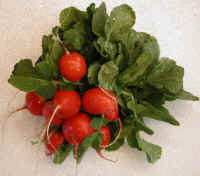
(Radishes)
This red-skinned radish is the most common variety. They are eaten raw in
salads or plain. When thinly sliced, their red outer skin and white inner
flesh add color to any salad or relish dish. They have a relatively mild
spicy taste. Select radishes that are fresh and crisp and bright in color.
It is harder to detect imperfections in packaged radishes, but if they are firm
to the touch and fresh and bright in appearance, they are usually quite good.
See the nutritional chart by clicking on the photo or link.
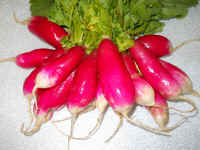
(Radish, French Breakfast)
The French breakfast radish is an elongated shaped radish with red tops and
white tips. They have good flavor and texture, which are excellent for dips,
sliced into salads, in relish trays, or as a garnish. We have only found
them for sale in farm markets. French breakfast radishes are related to the
turnip and horseradish family. This heirloom radish was first introduced in
Paris France in 1879, and became very popular, but no one seems to know
where the "breakfast" portion of the name came from. We could not find any
nutritional information specific to French breakfast radishes.

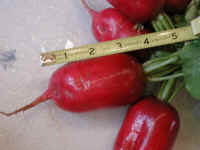 (Radish, Large Red) We found this large variety of red
radish in a local farm store. Their texture and taste is exactly like the
common red radishes that are sold in the supermarkets. They were wonderful
cut up in our salads. We purchased them several times until their season
ended in mid summer. We could not find any information about these large
red radishes on the internet, thus we could not include a specific nutritional chart.
(Radish, Large Red) We found this large variety of red
radish in a local farm store. Their texture and taste is exactly like the
common red radishes that are sold in the supermarkets. They were wonderful
cut up in our salads. We purchased them several times until their season
ended in mid summer. We could not find any information about these large
red radishes on the internet, thus we could not include a specific nutritional chart.
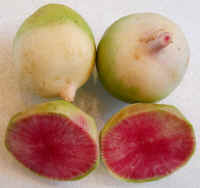
(Radish, Watermelon)
We purchased our watermelon radishes at a local farm store, and have not
seem them in local supermarkets, but they should be available from markets
that specialize in organic produce. The watermelon radish is made up of an
edible globular root attached to thin stems and wavy green leaves. Its
exterior is creamy white in color with pale green shoulders, a sign of the
chlorophyll it received from exposure to the sun. The watermelon radish's
flesh is white closest to the exterior becoming bright circular striations
of pink and magenta. Hence the watermelon reference. Its flesh is tender
crisp, succulent and firm. Its flavor is mild, only slightly peppery with
almond-sweet notes. Depending on when harvested, watermelon radishes can
range in size from golf ball to soft ball. The Watermelon radish,
given name Shinrimei, is also known as Rooseheart and Red Meat, is an
heirloom Chinese Daikon radish. It is a member of the Brassica (mustard)
family along with arugula, broccoli and turnips. The Watermelon radish
shares the same attribute with all radishes, it contains isothiocyanate, a
pungent chemical compound that when isolated makes an organic pesticide.
Often radish crops (along with other Brassica plants) release these
compounds which are toxic to pests, weeds and soil born-pathogens (from:
specialityproduce.com). We could not find any specific nutritional
information for watermelon radishes.
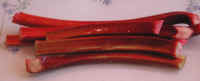
(Rhubarb)
The rhubarb petioles (leaf stems) in this photo are a deep red in color, but
rhubarb is often sold when it is more greenish in color. We have not
noticed much difference in the flavor, but we prefer the red because we believe
it is more nutritious. Rhubarb is bitter tasting by itself, but great when
cooked with fruit. Select rhubarb that is crisp and free of dried ends.
See the nutritional chart for raw rhubarb by clicking on the photo or link.
We could not find any data for cooked rhubarb without sugar. If the
rhubarb is cooked with other ingredients of a recipe, we would suspect that most
of the nutritional value would remain in the finished preparation.

(Spinach)
Spinach is a soft-leafed vegetable with a pleasant, slightly bitter taste.
Select spinach that is crisp and has a bright green color. Once spinach
begins to wilt, it spoils rapidly. Since spinach is usually grown in sandy
soil, it is important to clean it thoroughly. We suggest placing the
spinach in a sink about half full of cold water and agitating the spinach to
loosen as much of the sand as possible. Then thoroughly rinse each leaf
under running water. Raw spinach is also sold pre-washed in bags, but we
suggest that it be rinsed again before use. Raw spinach is a wonderful
addition to a salad, and can be steamed, or cooked in a number of recipes
calling for greens. See the nutritional chart by clicking on the photo or link.
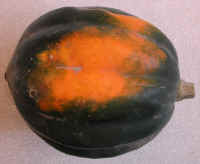
(Squash, Acorn)
Acorn squash are one of the winter squashes that are quite
plentiful in the autumn. They range in color from the common dark green to
yellow-orange, with combinations as in this one. The flavor of all of them
seems to be the same. Select acorn squash that are firm and free of damage
or signs of spoilage. See the nutritional chart by clicking on the photo or link.

(Squash, Butternut)
Butternut squash are delicious and highly nutritious.
We enjoy them split and baked (see
recipe). Served with a salad, baked butternut squash often are the
main course of our meal. We also like to toast the seeds (see
recipe). Select butternut squash that are firm and free of cuts or
blemishes. The photo of the split butternut squash (left) shows its bright
orange colored interior. See the nutritional chart by clicking on the photo or link.
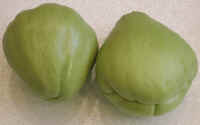
(Squash, Chayote)
Chayote squash looks something like a large somewhat
flattened pear with a skin color similar to a light green apple, and has small
ridges that run lengthwise. Chayote is a gourd-like member of the squash
family that, when cooked, has a similar flavor to zucchini squash. It also
has a single large edible seed in the middle that is quite flavorful.
Historically, chayote squash is a native of Central and South America, and was a
staple food of the Aztecs and Mayas. Select chayote that are small, firm
and unblemished. They can be stored whole in a plastic bag in the
refrigerator for up to a month. Chayote squash can be baked or added as an
ingredient to soups and stews. To enlarge the photo and see the
nutritional chart, click on the photo or link.

(Squash, Dumpling)
The dumpling squash, also referred to as sweet dumpling squash is a small
(4-inch diameter, mildly sweet-tasting winter (autumn) variety squash
resembles a miniature pumpkin with its top pushed in. It has cream-colored skin
with green specks, and green stripes. Dumpling squash weigh only about 7 ounces,
which make its sweet and tender orange flesh with it colorful skin an
attractive and great size for stuffing and baking as individual servings. The
seeds are also great for roasting as a snack. We could not find individual
nutritional information for dumpling squash, so we included only general squash information.

(Squash, Honeynut) Honeynut squash is an
interspecific hybrid winter squash cultivar bred from butternut and
buttercup squash in Geneva, New York. It has dark tan to orange skin with
orange fleshy pulp. When ripe, it turns from green to a deep orange and
becomes sweeter and richer tasting than butternut squash. When roasted, or
cooked in the microwave oven the skin becomes soft and tender and can be
eaten along with the flesh. We bought ours at Touch of Dutch Farm in
Richland Center, Wisconsin. We could not find any specific nutritional
information for this variety.

(Squash, Hubbard)
The Hubbard Squash is the largest squash we have seen in the
markets. Its orange flesh is very good tasting, and the whole squash is
excellent for stuffing as the entree of holiday feasts. See our recipe for
stuffed Hubbard squash. Select a squash
that is free from bruises and has a good appearance, if you intend to stuff it
(also make sure it will fit into your roasting pan). The Hubbard squash
received its name from Elizabeth Hubbard sometime around 1842, after she
distributed the seeds of this previously un-named squash produced by Knott
Martin. Our first encounter with Hubbard squash was on the island of
Jamaica, where this squash is called "pumpkin" and is made into a
curried soup (substitute 4 cups of Hubbard squash
for this recipe). See the nutritional chart by clicking on the photo or link.

(Squash, Lita)
In September of 2013, we found this lita squash, a variety of summer squash,
at a local farm store. This was our first experience with lita squash, so it
sparked our interest and we decided to do some culinary experimenting. Lita
squash are similar to zucchini, except they are sweeter. They can be eaten
either raw or cooked, and everything is edible except the stem and flower
ends. Raw pieces can be added to salads, and they can be cooked or roasted
as part of many different recipes such as those calling for zucchini or
yellow squash. We could not find any specific nutritional information for lita squash.

(Squash, Spaghetti)
Spaghetti squash is one of the sweet yellow/orange fleshy
winter squashes. The unique feature about spaghetti squash is that when
it's cooked, it breaks apart into strands that look like spaghetti. They
are quite plentiful in the autumn, and relatively inexpensive. Select
spaghetti squash that are firm, free of damage and with mostly a bright yellow
color. (The part of the squash that rested on the ground is lighter in
color.) See the nutritional chart by clicking on the photo or link.

(Squash, Yellow)
Yellow squash are great when cooked as a side dish, or cooked
with other vegetables in soups, stews, stir-fries, and pasta prima vera.
The smaller ones are good when eaten raw on salads and for dips. Select
yellow squash that are firm and free of blemishes and cuts. If buying by
weight, select the smallest ones, as they have smaller and more tender seeds.
See the nutritional charts for raw and cooked yellow squash by clicking on the photo or link.

(Squash, Yellow Zucchini)
Yellow zucchini are also referred to golden zucchini. We could not find any
significant difference between the yellow and green zucchini in the
literature; though from experience there would be a difference in the
phytochemicals in the skins, but we couldn't find any specific nutritional
information for yellow zucchini. Other than that, they can be eaten and
prepared in the same kinds of recipes. We have not seen them being sold in
any supermarket in the United States, and seem to be available only in the
summer in farm stores.
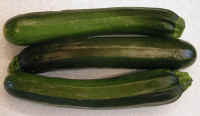
(Squash, Zucchini)
The zucchini squash in this photo are young ones that have
been picked early. They are the most tender and have no developed seeds.
They are excellent raw. You can slice them in rings for salads and slice
them in strips for dips. During the summer and early fall they are found
everywhere at farm stores and usually sold by count rather than by weight.
If they are sold by count and you are planning to cook them, select the larger
ones, as long as the outside hasn't begun to harden. If they are sold by
weight, always select the smaller ones. Select zucchini squash that are
firm (free of soft spots or ends) and free of blemishes. See the
nutritional chart by clicking on the photo or link.
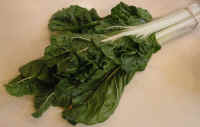
(Swiss Chard)
Swiss chard is the succulent leafy green tops and whitish stems
of a beet plant; however, the leaves of the Swiss chard are much larger than
those of the common beet. The name, Swiss chard, is often shortened to
"chard" and is sometimes called "leaf beet" or "sea-kale beet." Select
Swiss chard that is fresh (not wilting) and free of blemishes. There is
also a red leaf and stem variety, and recently, we have seen a yellow stem
variety. Swiss chard tastes somewhat like spinach. The bunch of
Swiss chard in this photo was about 2-1/2 feet (3/4 meter) tall. See the
nutritional chart by clicking on the photo or link.
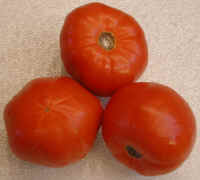
(Tomatoes)
There are many varieties of "round" tomatoes such are the ones pictured here.
Since they are generally all sold as "tomatoes", we have grouped them together.
The best tasting tomatoes are those that are vine ripened. Most commercial
tomatoes sold in the markets are picked just at the point when they are
beginning to turn red, and then they are ripened in transit being subjected to
ethylene gas just prior to delivery - as a result they never have a chance to
gain their full natural flavor. Select tomatoes that are firm and free of
bruises and wrinkles. See nutritional chart by clicking on the photo or link.

(Tomatoes, Black Cherry)
There are many varieties of "round" tomatoes such are the ones pictured here.
Since they are generally all sold as "tomatoes", we have grouped them together.
The best tasting tomatoes are those that are vine ripened. Most commercial
tomatoes sold in the markets are picked just at the point when they are
beginning to turn red, and then they are ripened in transit being subjected to
ethylene gas just prior to delivery - as a result they never have a chance to
gain their full natural flavor. Select tomatoes that are firm and free of
bruises and wrinkles. See nutritional chart by clicking on the photo or link.

(Tomatoes, Blue Beauty) Blue Beauty
tomatoes are slightly sweet and tangy, making them perfect for fresh salads
or even roasted in the oven. They are also packed with antioxidants and
other nutrients, making them tasty and nutritious. In the photo above, the
left tomato is really two tomatoes that grew together. Blue Beauty tomatoes
are not entirely blue. The top or “shoulders” of a Blue Beauty looks like
it’s stained a dark, rich hue. The dark stain bleeds into the rest of the
tomato as it ripens and which is red inside. We could not find any other
nutritional information.

(Tomatoes, Canned, Whole)
Whole canned tomatoes are usually found in 28-35-oz.
cans. Some brands add tomato juice or puree, sweet basil, salt, and citric
acid. The added ingredients would change the values listed in the
nutritional chart. We use whole called tomatoes for convenience, is
recipes calling for tomato pieces or chunks. To enlarge the photo and see
the nutritional chart, click on the photo or link.

(Tomatoes, Crushed)
Crushed tomatoes are usually found in 28-oz. cans. Most
contain added salt and citric acid (to preserve color), some have sweet basil
added, and others add thick tomato puree. The added ingredients can change the
nutrient content listed in the nutritional chart. The only places that
we've seen salt free crushed tomatoes is in health food stores, specialty super
markets, and from co-ops. We use crushed tomatoes in sauces, soups, stews, and
in some curry recipes. To enlarge the photo and see the nutritional chart,
click on the photo or link.
(Tomatoes, Diced)
We use canned diced tomatoes for convenience, and when fresh
tomatoes are out of season, or grossly over-priced. The only draw back is
that they usually contain salt, so we try to find canned diced tomatoes without
salt. They may also contain calcium chloride and citric acid, which are
not a problem. They are usually less expensive than whole canned tomatoes,
so they become the canned tomato of choice when the recipe calls for tomato
pieces. We could not find nutritional information for canned diced
tomatoes. See the nutritional chart below for whole canned tomatoes, which
should be the same as the diced tomatoes.

(Tomatoes, Grape)
The grape tomatoes in this full-sized photo are about three
times their actual size. Grape tomatoes taste very similar to other
tomatoes, and they cost more than full size tomatoes, but they are great in
salads. We think of them more as a fun food tomato. We grew twelve
of these small tomato plants in one of our deck planters. Few of them
reached our table, as we kept eating them off the vine. Choose grape
tomatoes that are firm and bright red. We could not find any specific
nutritional data for grape tomatoes. See the nutritional chart for tomatoes.

(Tomatoes, Hugh's Heirloom)
These Hugh's tomatoes are an heirloom beefsteak variety from Madison County,
Indiana in the 1940's. The plants produce generous amounts of 1 to 2 pound,
pale-yellow to orange, thin-skinned (delicate), meaty fruits that are
bursting with luscious, robust, sweet tomato flavors. Even though these
tomatoes have been around for 60 years, we have not seen them is any
supermarket. We purchased ours at Touch of Dutch Farm in Richland Center,
Wisconsin. We could not find any specific and comprehensive
nutritional information for these tomatoes.

(Tomatoes, Lemon Boy Plus)
The lemon boy plus is a delicious yellow tomato. They are great for slicing
for sandwiches or cut on salads. It's an updated version of the classic
Lemon Boy tomato with added disease resistance and sweet, tangy flavor—a
marked improvement over typical yellow tomatoes. The flattened-round, 7–8
oz. beefsteak fruits are consistent in size, shape, and quality with very
few blemishes. They are a high-yielding variety with good firmness. We have
not seen them in any supermarkets, and purchased ours at Touch of Dutch Farm
in Richland Center, Wisconsin. We could not find any specific nutritional
information for these tomatoes.

(Tomatoes on the Vine) Tomatoes on the vine,
at times may seem like an advertising gimmick, because the flavor and taste
may not seem any different, but technically they are left growing on the
vine to a later stage of ripening (so they just begin to turn red, which
should make them sweeter and more uniformly redder. We generally only buy
them when they are on sale, because the slight difference in flavor is not
worth the difference in cost. They never seem to be as good as the vine
ripened tomatoes that we get at a farm stand.

(Tomatoes, Orange Jazz Heirloom)
These Orange Jazz Heirloom tomatoes are famous for rich, sweet flavor!
However, they seem to lose some of that flavor when they become over ripe
and soft. These beautiful beefsteaks are low acid and fruity tasting, justly
earning top marks in our tomato tasting trials. We noted sugary sweet and
complex flavor with a hint of peach. We purchased ours at Touch of Dutch
Farm in Richland Center, Wisconsin. We could not find and comprehensive
nutritional information for these tomatoes.
(Tomatoes, Roma)
This oval or pear shaped tomato goes by a variety of names:
Roma, Italian and plum. They have more pulp and less water content than
the round varieties, thus they are better for cooking and making sauce. We
also enjoy them in our salads. The best tasting tomatoes are those that
are vine ripened. Most commercial tomatoes sold in the markets are picked
just at the point when they are beginning to turn red, and then they are ripened
in transit being subjected to ethylene gas just prior to delivery - as a result
they never have a chance to gain their full natural flavor. Select
tomatoes that are firm and free of bruises and wrinkles. See nutritional
chart by clicking on the photo or link.

(Tomatoes, Sart Roloise)
The Sart Roloise tomato is bursting with sweet, fruity and complex flavor
with just the right acidity, owing its tropical flavor profile to its
parentage. This is one of the few anthocyanin tomatoes available that have a
cream or light yellow bottom with purple/black shoulders. The shoulder
coloration gets darker when exposed to the sun. Truly unique. It started as
a cross between White Wonder and Baby Blue tomatoes. It has been stabilized
through the generations and is an heirloom tomato with savable seeds. The
inside flesh is solid light yellow, very meaty, and has few seeds. The
plants produce fruits in clusters that are consistently beefsteak size. We
bought ours at Touch of Dutch Farm in Richland Center, Wisconsin. We could
not find any specific nutritional information for this heirloom tomato.

(Tomatoes, Sun-Dried)
Sun-dried tomatoes are relatively expensive, but they add a
delicious gourmet touch to some recipes. Apparently, the origin of
sun-dried tomatoes is Italy, where prior to the days of canning, tomatoes were
dried in the sun on the tile roofs. We have a couple of
bread recipes in which we've incorporated sun-dried tomatoes. See the
nutritional chart by clicking on the photo or link.
(Tomato Paste)
Tomato paste is made by cooking tomatoes for several hours
until enough of the water is boiled off to reduce the tomatoes to a thick red
concentrate. The cooked tomato concentrate is them strained and packaged
for sale. Tomato paste is most commonly found packaged in 6-oz. cans.
When purchasing tomato paste, look at the label to make sure that the only
ingredient is tomatoes. We use tomato paste in a wide variety of dishes
such as soups, stews, and sauces. Tomato paste is also the least expensive
way to add a tomato flavor to a recipe. Tomato paste is also a great source of
lycopene. See the nutritional by clicking on the photo or link.
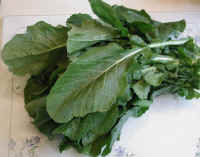
(Turnip Greens)
Cooked turnip greens have a very robust (heavy) flavor.
They can be eaten as a side dish or cooked with other greens or veggies in
various recipes. Select turnip greens that are crisp and green and free of
wilt or discolored edges. Turnip greens are a great source of vitamin A
and K, beta carotene, and lutein. See the nutritional chart by clicking on
the photo or link.
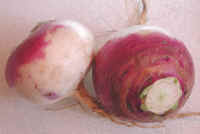
(Turnips)
Turnips are a root vegetable that are grown in temperate climates around the
world. Their history as an established crop goes back more than 2,000
years to Greek and Roman times. We eat turnips cut up raw in salads and in
strips with dips, as they have a radish-like flavor. Turnips can be cook by
themselves or in stews and soups, and we have also cut them into strips and
roasted them, as finger food. Click on the photo or link to see the
nutritional charts for raw and cooked turnips.

(Turnip, Red)
There are several varieties of red turnips. This variety appears to be a
traditional or hybrid Japanese turnip. The roots or these varieties are
semi-globed to more flattened with deep red or scarlet red skin with white
flesh that is tender and crisp. They have a delicious, sweet to a mild
radish-like flavor when harvested young to full maturity. The turnip tops
were already removed from these red turnips when we acquired them, so we
could not identify the variety, but red turnip tops are all green with green
or red stems. We could not find any detailed nutritional information for red turnips.
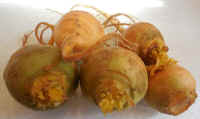
(Turnips, Yellow)
According to the literature, yellow turnips with yellow flesh are neither
hard to find nor hard to grow, however we have not found these yellow
turnips in the supermarket, and not always at farm stores. The literature
also says that the much more common varieties are very similar in taste and
texture, but we have found that these yellow turnips are milder tasting and
great for eating raw in salads. They also can be cooked in a wide variety of
recipes. We could not find specific nutritional information for yellow
turnips. See general nutritional information for turnips.

(Water Chestnuts, Canned)
Water chestnuts are a wonderful addition to Chinese and Asian recipes, which add
a crunchy texture to the dish. We only buy the ones that are canned in water
with no additives. Unfortunately, during the canning process they lose some of
their sweetness and the layers of flavor that fresh water chestnuts possess.
Since we don't live near to where this aquatic vegetable is grown, we only have
access to the canned water chestnuts, but if you can buy the fresh water
chestnuts, it is well worth the treat. What we eat as water chestnuts, are not
really a type of nut, but the sliced root corms of the water chestnut plant
which grow in the mud of the marsh, much in the same way that potatoes grow on
dry land. We could not find any detailed nutritional information, but some
of the literature states that they are high in carbohydrates, and are also a
good source of dietary fiber, riboflavin, vitamin B6, potassium, copper, and manganese.
Return to: Ingredients Description and Photos
 The
above recipe is in keeping with God's creation intent (Genesis 1:29-31):
'Then God said, "I give you every seed-bearing plant on the face of the whole earth and every
tree that has fruit with seed in it. They will be yours for food. And to all the beasts of the
earth and all the birds of the air and all the creatures that move on the ground-- everything that
has the breath of life in it-- I give every green plant for food." And it was so. God saw all
that he had made, and it was very good.' (NIV) Let no animal suffer or die that we may live!
The
above recipe is in keeping with God's creation intent (Genesis 1:29-31):
'Then God said, "I give you every seed-bearing plant on the face of the whole earth and every
tree that has fruit with seed in it. They will be yours for food. And to all the beasts of the
earth and all the birds of the air and all the creatures that move on the ground-- everything that
has the breath of life in it-- I give every green plant for food." And it was so. God saw all
that he had made, and it was very good.' (NIV) Let no animal suffer or die that we may live!
Recipe Section
Main Web Site
- Home Page
- What's New
- Contact Us
- Action Alerts
- Animal Exploitation
- Animal Issues
- Animal Rights Activism
- Archives
- Art & Photography
- Articles Directory
- Bible
- Bible Commentary Blog
- Books
- Campaigns
- Church & Religion
- Discussions
- Donate
- Events / Podcasts / Media
- Health
- Hosted Sites
- Humor
- Kids' Korner
- Letters
- Links
- Nature Studies
- Newsletter
- Poetry & Stories
- Prayers
- Quotations
- Recipes with Photos
- Recipes Without Photos
- Sermons
- Stop Cruelty in Churches
- Video Library
- The Mary T. and Frank L. Hoffman Family Foundation
Follow us on:


A web site sponsored by The Mary T. and Frank L. Hoffman Family Foundation and all-creatures.org
Copyright © 1998-2026 The Mary T. and Frank L. Hoffman Family Foundation. All rights reserved. May be copied only for personal use or by not-for-profit organizations to promote compassionate and responsible living. All copied and reprinted material must contain proper credits and web site link www.all-creatures.org.
Fair Use Notice: This document, and others on our web site, may contain copyrighted material whose use has not been specifically authorized by the copyright owners. We believe that this not-for-profit, educational use on the Web constitutes a fair use of the copyrighted material (as provided for in section 107 of the US Copyright Law). If you wish to use this copyrighted material for purposes of your own that go beyond fair use, you must obtain permission from the copyright owner.
Thank you for visiting all-creatures.org.
Since 